

Recent reports indicate that Tesla is accelerating its upcoming Cybercab wireless charging program. It has achieved a key breakthrough in US regulatory approvals. The Federal Communications Commission (FCC) recently approved Tesla’s use of ultra-wideband radio technology, or UWB, for inductive charging in the United States. This cleared a significant regulatory hurdle for its fully automated wireless charging solution.
Cybercab is Tesla’s planned driverless taxi product, eliminating the steering wheel and pedals and relying entirely on its Autopilot system. Reports indicate that the first two-seater Cybercab has rolled off the production line at Tesla’s Austin factory. This marks the vehicle’s approach to mass production. Incidentally, UWB technology is expected to help support seamless charging for these autonomous taxis. It is expected to launch before 2027, with a starting price of approximately $30,000.
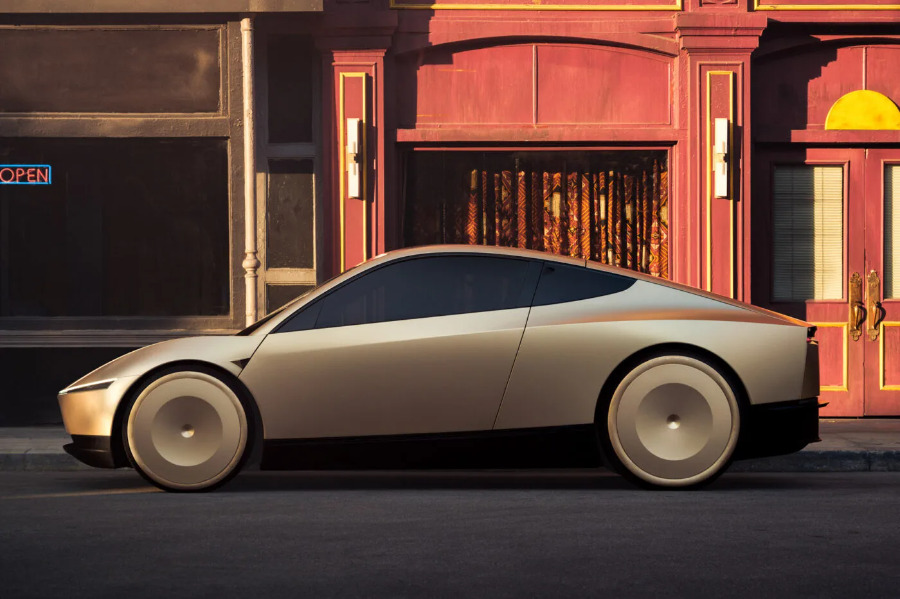
Its design philosophy is to operate without a driver. However, to achieve a truly autonomous fleet, vehicles must not only be able to navigate autonomously but also charge without human intervention. This exemption will provide the necessary infrastructure to achieve this goal. Among other advancements, the adoption of UWB enables vehicles to automatically return to base. It also allows them to automatically adjust their direction and charge. This is a small but far-reaching regulatory decision. It signifies that cars can not only drive themselves but also charge themselves.
This certification specifically targets Tesla’s positioning system, which enables precise alignment between the vehicle and the ground-based wireless charging pad. Before the UWB function activates, the vehicle establishes a Bluetooth connection to identify the charging station. When the vehicle approaches the charging station, the UWB signal briefly activates to guide the vehicle to the optimal location. Once aligned, UWB transmission stops, and wireless power transmission begins.

The FCC determined that Tesla’s UWB system operates at extremely low power, over very short distances, and is only used briefly while the vehicle is parked. Thus, it minimizes the risk of interference to other spectrum users. This technical distinction is crucial because UWB devices are typically limited to handheld use. They are also prohibited from use on fixed outdoor infrastructure.
The UWB signal only appears briefly when the vehicle approaches the charging platform, primarily between the vehicle and the ground platform. It is significantly attenuated by the vehicle body, having limited impact on the surrounding environment. Ultimately, UWB will be deployed once Bluetooth transitions out of the initial charging guidance phase.