

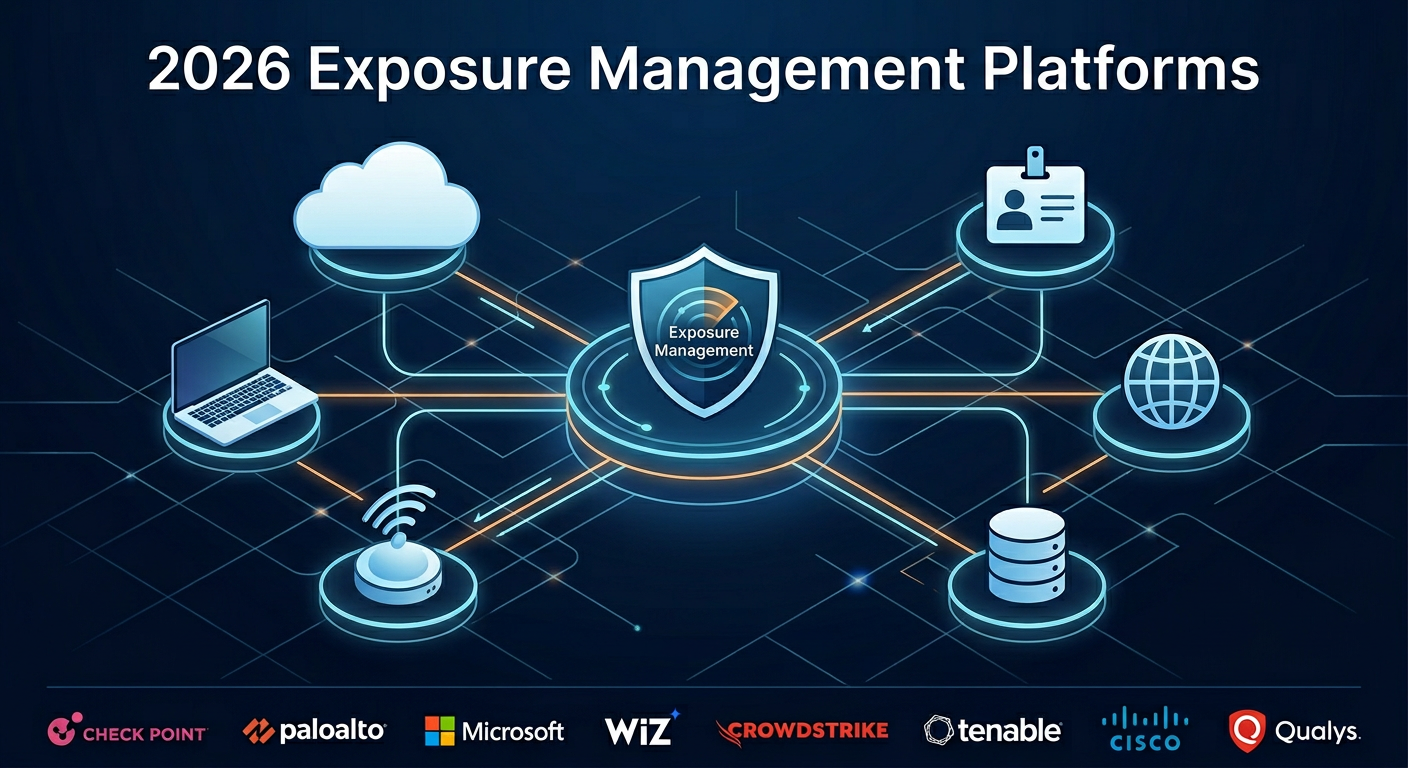
Security teams today face a threat landscape that has shifted dramatically compared to just a few years ago. The focus is no longer limited to patching servers or closing well-known ports. Instead, cloud accounts, SaaS tools, iot devices, exposed APIs, forgotten domains, and over‑privileged identities create a constantly evolving attack surface.
As a result, exposure management platforms have become a cornerstone of modern security programs. Below is a closer look at the key platforms to watch in 2026, starting with Check Point and moving through other notable players in the space.
The New Imperative: From Vulnerabilities to Attack Paths
Traditional vulnerability counts no longer tell the full story. Attackers now weave together misconfigurations, excessive permissions, and internet‑facing assets to move laterally across hybrid environments. Exposure management platforms address this by connecting data across networks, clouds, identities, and applications — helping teams focus on the relatively few issues that meaningfully change their risk posture.
Key Vendors and Their Approaches
1. Check Point – Enterprise‑Wide Exposure Management
Check Point has long been known for firewalls and threat prevention, but it has steadily expanded into broader visibility and risk management. Its exposure management solutions provide security teams with a unified view of what is actually exposed — across networks, cloud accounts, and remote users.
Rather than treating vulnerabilities, misconfigurations, and identity risks as separate streams, the platform weaves them into a single risk story. It maps which assets are truly internet‑facing, which identities hold excessive permissions, and where configuration gaps create real attack paths. For organizations already using Check Point products, this approach reduces tool sprawl and makes it easier to feed exposure data into existing monitoring, incident response, and policy enforcement workflows — without turning into an overhyped “single pane of glass.”
2. Palo Alto Networks Prisma Cloud – Cloud‑Native Attack Path Analysis
Prisma Cloud tackles exposure management from a cloud‑native angle. It combines CSPM, CIEM, and workload protection while highlighting how resources, identities, and services connect to form potential attack paths. Its strength lies in relationships: who can access what, from where, and under which conditions. For teams running heavily on AWS, Azure, or Google Cloud, Prisma Cloud answers practical questions such as “If this key is compromised, what can an attacker realistically reach?” — rather than just listing misconfigurations.
3. Tenable One – Risk‑Based Exposure Scoring
Tenable has long been associated with vulnerability scanning, but Tenable One represents its move into full exposure management. The platform aggregates data from IT assets, cloud environments, web apps, and identity systems, then scores exposure based on exploitability and business importance. This risk‑based lens helps teams overwhelmed by findings: instead of working through a spreadsheet line by line, they can focus on the small number of issues that truly change their attack surface.
4. Microsoft Defender External Attack Surface Management – Discovering Shadow IT
Microsoft’s Defender EASM focuses on what the internet can see: domains, subdomains, IP addresses, and services associated with an organization — whether officially documented or not. For large enterprises with shadow IT or forgotten infrastructure from acquisitions, this reveals assets no one knew were still exposed. When paired with the broader Defender and Entra ecosystem, this external view can be linked to internal identities and resources, making it easier to connect an old exposed web service to the actual business unit responsible for fixing it.
5. Wiz – Graph‑Based Cloud Context
Wiz has gained traction for its agentless cloud security approach. It scans cloud environments to collect information about workloads, configurations, secrets, and permissions, then builds a graph of how those elements interact. In practice, this means the platform does not just show that a database is misconfigured — it tries to show whether a realistic attack chain exists from an exposed asset to that database, using actual permissions and network paths. This graph perspective has made Wiz popular with fast‑moving cloud organizations that need to understand how multiple small issues can combine into a serious breach.
6. CrowdStrike Falcon Exposure Management – Merging Vulnerabilities with Active Threats
CrowdStrike uses its endpoint and workload visibility as a foundation for exposure management. The platform joins vulnerability and configuration data with telemetry from its EDR/XDR capabilities, so teams can see not only what is exposed but also what is being probed or attacked in real time. This is invaluable for prioritization: if a set of assets is both vulnerable and actively targeted by real‑world threats, it naturally moves higher up the queue than a dormant system with the same CVE count.
7. Cisco Panoptica – Visibility for Distributed Applications and APIs
Cisco’s security portfolio continues to evolve into a more unified cloud and application security story. Panoptica focuses on applications, APIs, containers, and microservices spread across different cloud providers and Kubernetes clusters. From an attack surface perspective, it helps teams see which services are actually reachable from the internet, how data travels between them, and where misconfigurations or overly permissive access might open doors. For those managing distributed, microservice‑heavy architectures, this kind of map is far more actionable than a traditional network diagram.
8. Qualys TruRisk Platform – Contextual Risk Prioritization
Qualys, another long‑standing player in vulnerability management, has shifted toward exposure and risk with its TruRisk approach. The platform brings together vulnerabilities from endpoints, servers, containers, web apps, and cloud instances, then layers in context such as asset criticality, exploit availability, and compensating controls. The result is a realistic sense of which issues meaningfully change the organization’s exposure. That helps security leads explain to non‑technical stakeholders why some “medium” issues may demand immediate attention, while certain “high” findings can reasonably be scheduled for later.
IoT Context: Expanding the Attack Surface
The importance of exposure management is even greater in IoT environments, where large fleets of connected devices extend the attack surface beyond traditional IT and cloud assets. These devices often have long lifecycles, limited security capabilities, and complex integrations with edge and cloud systems. As IT and OT converge, a misconfigured gateway, API, or identity can create new attack paths between connected devices and core infrastructure. Consequently, exposure management platforms are increasingly expected to include IoT and edge assets to provide a more complete view of risk across hybrid environments.
Conclusion: A Foundational Shift in Security
The common thread across these platforms is a clear move away from raw vulnerability counts and toward an understanding of how attackers actually move through an environment. In 2026, managing attack surface and exposure is less about collecting data and more about connecting it across clouds, identities, applications, and traditional networks.
Check Point’s exposure management offering, along with tools from Palo Alto Networks, Tenable, Microsoft, Wiz, CrowdStrike, Cisco, and Qualys, all tackle this same problem from slightly different angles. Which platform fits best depends on existing technology choices, infrastructure locations, and team preferences. But regardless of vendor, the direction is unmistakable: exposure management is becoming a foundational part of security — not just another add‑on module.

About the Exhibition
This development highlights the growing convergence of IoT, smart home technologies, and digital identity solutions—key themes at IOTE – The International Internet of Things Exhibition, a leading global platform for RFID, nfc, and IoT innovation.
The upcoming IOTE 2026 International Internet of Things Exhibition Shenzhen will take place in Shenzhen, bringing together industry leaders, technology providers, and solution innovators to showcase the latest advancements in smart homes, connected devices, and secure access technologies .