

Amazon isn’t replacing humans with robots; instead, it’s leveraging AI, artificial intelligence, and IoT devices to enhance its workforce.
For executives, the primary goal remains finding faster, more efficient ways to work. Additionally, they aim to ensure employee safety and reduce mental workload. Whether it’s warehouses or delivery routes, the real test lies in the actual effectiveness of digital solutions in the real world.
Amazon states that they aim to continuously explore innovative ways to improve the safety and convenience of the work experience. This includes making work safer, smarter, and more valuable. For managers, it’s crucial to understand that they utilize technology to reduce the physical and mental strain on employees. Managers view technology as a tool to assist workers, not a means to replace them.
Empowering Employees: From Warehouse to Your Doorstep
Amazon is leveraging IoT and AI technologies to address challenges in two key areas. Specifically, they focus on repetitive manual labor in warehouses and the high-risk, unpredictable nature of package delivery.
Technology Enables Delivery
Delivery drivers face numerous challenges: navigation, package handling, and personal safety. Amazon is exploring solutions using smart glasses. This wearable device aims to create a hands-free delivery experience for employees.
These glasses are specifically designed for delivery work. Using a screen projected in front of the driver, AI, and computer vision technology, they display critical information directly in the driver’s field of vision. This helps scan packages, confirm delivery status, and provide route guidance. This technology offers two major advantages: increased efficiency and enhanced safety.
“Because the glasses display information directly in my field of vision, I feel safer throughout the entire process,” said Kaleb M., a delivery driver for Maddox Logistics in Omaha, Nebraska, who participated in the technology’s testing. “No need to look down at your phone; you can keep your gaze forward, beyond the screen — always focused on what’s ahead.”
Future plans include not only providing navigation but also proactively managing risk. For example, the glasses can alert drivers if they’ve gone to the wrong address. They can also point out hazards such as dim lighting or pets.
Artificial Intelligence and Robots in Warehouses
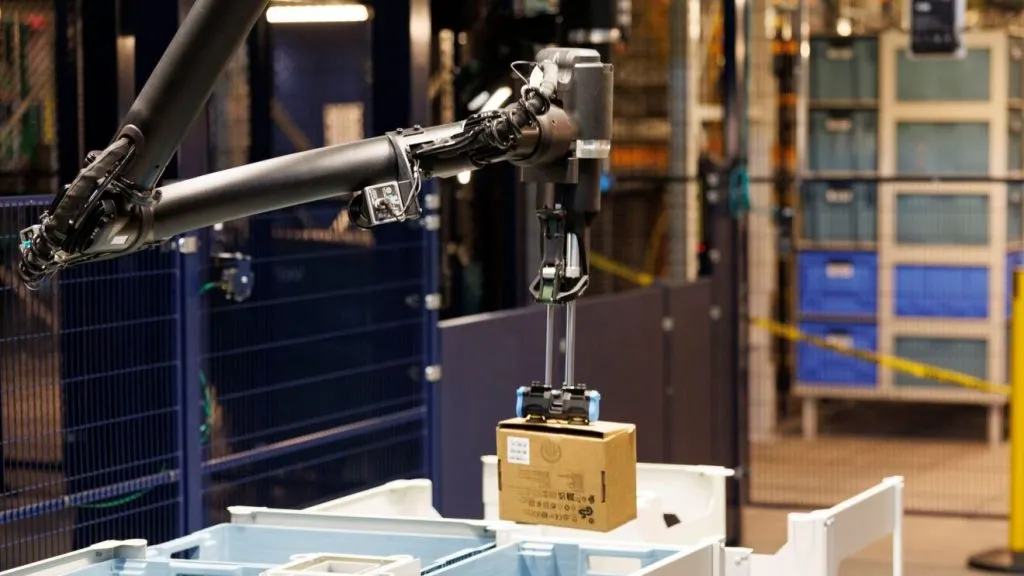
In Amazon warehouses, they are using a new robotic IoT system called “Blue Jay” to help employees with heavy manual labor. This next-generation robotic system is a prime example of AI application. Specifically, it integrates three separate robotic workstations into a streamlined workspace for picking, storing, and organizing items.
Its immediate advantage is achieving greater speed in a smaller space, thus accelerating delivery. For employees, it allows them to work in a comfortable posture. It also reduces repetitive reaching and lifting movements, thus lightening their workload. At a test site in South Carolina, “Blue Jay” is already able to handle approximately 75% of the various types of items.
Another important project is “Project Eluna.” This is an AI system designed by Amazon to assist operations managers (not just employees). It aims to solve the problem of managers feeling overwhelmed by the need to navigate dozens of dashboards and make rapid decisions.
Eluna acts as an extra teammate, using past and present data to predict problems and offer solutions. It not only presents data but also provides clear, data-driven recommendations. For instance, when asked simple questions like, “Where should we move our people to avoid problems?”
Its goal is to bring about critical change for all operations leaders: less firefighting and more proactive planning. This allows managers to spend more time mentoring their teams instead of frantically chasing data.
Accelerating Development with Digital Twins and Team Collaboration
How Amazon creates and uses these IoT and AI systems for its employees is just as important as the technology itself.
A major challenge with industrial robots is the long development cycle. Amazon engineers used AI and digital twin technology to shorten Blue Jay’s development cycle. They successfully reduced it from the typical three years to just over a year. Notably, Amazon used this advanced digital approach to simulate the real world. It demonstrates how this method can help teams conduct virtual testing and transform years of physical testing into months of digital work.
Furthermore, this technology was not developed in isolation. Take smart glasses as an example. Hundreds of drivers tested early versions and provided crucial feedback. This teamwork impacted every aspect of the glasses, from wearing comfort to display clarity. This focus on real-world applications is essential for getting people to adopt the technology and see a return on investment.
This launch is also based on a clear understanding: technology needs to learn new skills. Amazon invests in training programs and AI-specific education to equip employees with proficiency in using AI tools.
The rollout of AI like Eluna also demonstrates the critical importance of having robust, large-scale data systems. These systems, capable of thinking and proposing action suggestions, represent the next step in the development of foundational models across the industry. This is true whether on AWS Bedrock, Google Vertex AI, or other platforms. They require a reliable data solution, such as Amazon’s own DeepFleet AI model (used for managing bot swarms), to function effectively.