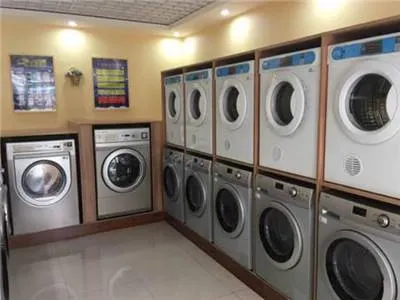
In South Korea’s 5 trillion won rental market, Uisikju’s Laundrygo is leveraging technological innovation, such as RFID tracking, and business model reform to break down the boundaries of the traditional laundry industry. It has transformed from a pioneer in B2C laundry services into a disruptor in the B2B rental sector, bringing a completely new service experience to hotels, hospitals, fitness chains, and other industries.
Laundrygo’s transformation path is clear and resolute. After launching its mobile laundry service in 2019, it quickly established a foothold in the B2C market. Following the acquisition of the Clean Nuri factory in 2022, it decisively shifted its focus to the B2B sector. In just a few years, this factory, which once had annual sales of only 2 billion won, is projected to see its sales soar to 13 billion won this year, serving 49 institutions including five-star hotels, with B2B revenue now accounting for 20% of its total revenue.
Behind this leapfrog growth lies its precise grasp of market pain points — compared to the 30% to 40% penetration rate of rental services in hotels and hospitals in Europe and the United States, the usage rate in the South Korean market is less than one-thousandth, signifying enormous development potential. Laundrygo draws on the full-chain service models of leading global companies such as Cintas and Elis, expanding its business from simple laundry outsourcing to an integrated service encompassing “supply-rental-washing-management,” creating a rental service system specifically for the South Korean market.
Breaking the Mold with RFID
Technological innovation is Laundrygo’s core lever for market dominance, with the application of RFID technology being a particularly brilliant touch. Traditional hotel laundry services are like a “black box,” with unclear tracking of clothing quantities, flow monitoring, and usage status assessment.
Laundrygo, however, embeds a chip in each garment awaiting laundry, achieving full-process digital recording from receipt, washing, drying, ironing to dispatch. Customers can view the washing frequency, purchase date, remaining shelf life, and inventory status of items such as towels and sheets through an app, enabling them to accurately determine the best purchasing time and significantly reduce the operating costs and space occupancy of linen rooms. Combined with automated equipment in its smart factory, such as a track-hanging system that automatically transports hotel sheets to ironing equipment and an automated folding system that efficiently handles standardized towel sizes, Laundrygo elevates the efficiency and standardization of its laundry rental services to new heights.
The continued expansion of its business scenarios demonstrates Laundrygo’s development ambitions. Following its sheet rental service for business hotels, this month it launched sportswear and towel rental services in over 70 large fitness chains nationwide. In the future, the company plans to extend its business to the supply and inventory management of toiletries such as shampoo and conditioner. This expansion is not blind but a natural extension based on standardized operations — when towel and clothing sizes are standardized across different stores, the efficiency of automated production processes will be further improved, forming a positive cycle of “standardization — automation — scale”.
Laundrygo’s rise is not an isolated case, but a microcosm of the booming B2B laundry market in South Korea. While the home laundry market is susceptible to seasonality and economic fluctuations, the B2B market, comprised of hotels, hospitals, and uniform providers, enjoys stable demand. Furthermore, its bulk processing model improves logistics efficiency and reduces labor costs, becoming the core driver of industry growth. Industry leader Cleantopia has seen an average annual growth of 40% in its B2B business over the past three years and has expanded its hotel laundry and rental business through acquisitions; Laundry Special Forces also plans to enter this market. Capital investment remains strong; LG Electronics invested 1 billion won in Laundrygo last year and is expanding its B2B channels through a partnership with a leading US commercial laundry solutions provider, demonstrating its long-term optimism about this sector.
From B2C to B2B, from simple laundry to full-chain rental management, Laundrygo, with RFID technology at its core and standardized operations as its foundation, has not only filled a gap in the South Korean rental market but also restructured the industry’s service logic. With continuous technological iteration and the enrichment of business scenarios, this “game-changer” is leading the South Korean B2B laundry rental market towards a vast future of 5 trillion won, providing a valuable reference for the transformation of the global laundry industry.
Why are more and more laundry companies adopting RFID?
In recent years, an increasing number of laundry companies have adopted RFID, primarily because it can solve long-standing pain points in the industry such as high labor costs, chaotic linen management, and difficulty in tracing washing quality. It creates value for enterprises in terms of efficiency, cost, and service. Specific reasons are as follows:
Improved operational efficiency: RFID technology, through contactless batch reading and writing, reduces linen receiving, dispatching, and inventory from several hours to just over ten minutes. Intelligent sorting systems replace manual visual identification, significantly reducing human intervention. This not only increases receiving and dispatching efficiency by over 300% but also reduces the error rate of manual operations, completely overcoming the inefficiency of traditional models.
Precise Cost Control: RFID enables end-to-end tracking of linens, pinpointing the points and locations of loss, significantly reducing linen loss rates from 15%-20%. It also automatically records washing cycles and issues early warnings for waste points, preventing waste and extended use. Automated processes reduce manual labor by over 60%, and dynamic inventory management optimizes replenishment plans, increasing inventory turnover by approximately 40%, significantly reducing labor, warehousing, and loss costs.
Ensuring Washing Quality and Service Upgrades: RFID records key parameters such as washing temperature and disinfection time in real time, creating traceable digital archives. This increases the sterilization pass rate for high-risk scenarios such as medical linens to over 99.5%, meeting compliance requirements. Some companies also allow customers to scan codes to view washing records, making commitments like “one customer, one change” visible, enhancing customer trust and partnership loyalty.
Supporting Digital Transformation and Competitiveness Enhancement: RFID-collected end-to-end data is uploaded to the cloud in real time, creating visualized operational archives. This provides data support for decisions such as linen procurement and transportation route optimization, enabling companies to shift from experience-based management to precise decision-making. Digital management not only reduces operational losses such as vehicle empty running rates, but also creates differentiated service advantages, helping companies gain a competitive edge in the market and win orders from large clients such as hotels and hospitals.