


In the 21st century, China has entered an era of advanced digitalisation and information technology. Continuous innovation in telecommunications and internet technologies has paved the way for the development of optical communications and the Internet of Things (IoT), bringing greater convenience and efficiency to both industrial operations and everyday life. As these technologies become increasingly integrated into industries worldwide, the convergence of optical communications and IoT is playing an increasingly important role in driving digital transformation and technological innovation.
After decades of development, China’s optical communications industry has expanded significantly in both scale and product diversity, establishing a relatively comprehensive industrial ecosystem. This includes optical transmission equipment, optical access equipment, supporting infrastructure, optical fibre and cables, and optical components and devices. In recent years, the industry has maintained strong growth, with reported annual growth rates of 30%–40%. China has also become the world’s largest optical communications market, home to internationally recognised companies such as Huawei, ZTE, Accelink Technologies, FiberHome Technologies, Innolight and Hengtong Optic-Electric.
The rise of the big data era has accelerated the development of cloud computing. Advances in communication technologies, increasingly data-intensive consumer and business activities, and the rapid expansion of digital information have driven demand for more powerful data infrastructure. As data becomes an increasingly valuable asset in the digital economy, big data analytics requires substantial storage capacity and high-performance computing resources. Cloud computing has emerged as a fundamental infrastructure model to meet these demands.
The growth of the cloud computing industry has, in turn, fuelled the expansion of Internet Data Centres (IDCs). Supported by internet connectivity and network bandwidth resources, IDCs provide carrier-grade facilities and professional services, including server hosting, colocation and rental services. Optical communications play a critical role in this infrastructure, enabling high-speed data transmission and interconnection within and between data centres.
Optical modules are essential components of these networks, supporting high-capacity, high-speed data transmission. Meanwhile, the rapid rollout of 5G networks is accelerating mobile infrastructure upgrades and driving large-scale 5G base station deployment. This is creating growing demand for optical modules and related technologies, while opening up further opportunities for domestic suppliers and the localisation of the supply chain.
Together, advances in optical communications, data centre infrastructure, cloud computing and 5G are providing a strong technological foundation for the wider adoption of IoT applications and the continued development of the connected digital economy.
Optical Communications Sector
- Fibre Lasers, Fibre-Optic Sensors & Applications: Fibre lasers, fibre-optic sensors, fibre Bragg gratings (FBGs) and laser light sources.
- Optical Communication Components (Active and Passive): Lasers, photodetectors, optical amplifiers, repeaters, connectors, optical switches, optical multiplexers, waveguide devices, optical transceiver modules, wavelength division multiplexing (WDM) devices, attenuators, filters, couplers, splitters, wavelength converters, grating devices, optical circulators, fibre arrays, PLC splitter modules, optical crystals and integrated optical devices.
- Optical Modules: 1×9, GBIC, SFP, XFP, SFP+, XPAK, XENPAK, X2 and CFP optical modules.
- Optical Communication Systems & Equipment: Fibre-optic transmission systems; broadband access solutions, including fibre access and integrated access systems; multi-service management platforms; multiplexing equipment; optical terminal equipment, including PDH equipment, optical telephones and multi-service optical terminals; fibre-optic transceivers; interface converters; protocol converters; mode converters; optical network terminals (ONTs); optical network interface cards; fibre-optic distribution equipment; and optical communication gateways.
- Optical Communication Supporting Systems & Components: Optical distribution frames (ODFs), patch panels, media converters, fibre fusion splicers, fibre polishing machines, fibre-optic splice closures, ferrules, sleeves, loose components, plastic optical fibre (POF) and photonic integrated circuits (PICs).
Cloud Computing & Big Data Sector
- Cloud Computing Technologies: Edge computing, software development platforms, API platforms, cloud platforms, IoT middleware platforms, quantum computing, Infrastructure as a Service (IaaS), Platform as a Service (PaaS), Software as a Service (SaaS), private cloud services, public cloud services, hybrid cloud services, community cloud services, full-stack cloud services, Industrial IoT platforms and smart industrial park management platforms.
- Big Data Technologies: Data centres, Internet Data Centres (IDCs), servers, data middleware platforms, data visualisation platforms, data acquisition and integration platforms, data analytics platforms, time-series databases, data storage solutions, data security solutions, Business Intelligence (BI) analytics platforms and AI-powered big data analytics.
- Integrated Application Solutions: IoT industry solutions, smart industrial park and smart community solutions, smart home solutions, smart campus solutions, smart building solutions, smart logistics solutions, anti-counterfeiting and product traceability systems, smart transportation solutions, smart construction site solutions, intelligent manufacturing solutions and connected vehicle solutions.










-
 Fudan Microelectronics New Product LaunchNovember 3rd 2026
-
 RFID Elite Networking DinnerNovember 2nd 2026
-
 IOTE 2026 Shenzhen | Digital Printing & Smart Label Applications ForumOctober 29th 2026
-
 IOTE 2026 Shenzhen | Anti-Counterfeiting & Traceability Technology Applications ForumOctober 29th 2026
-
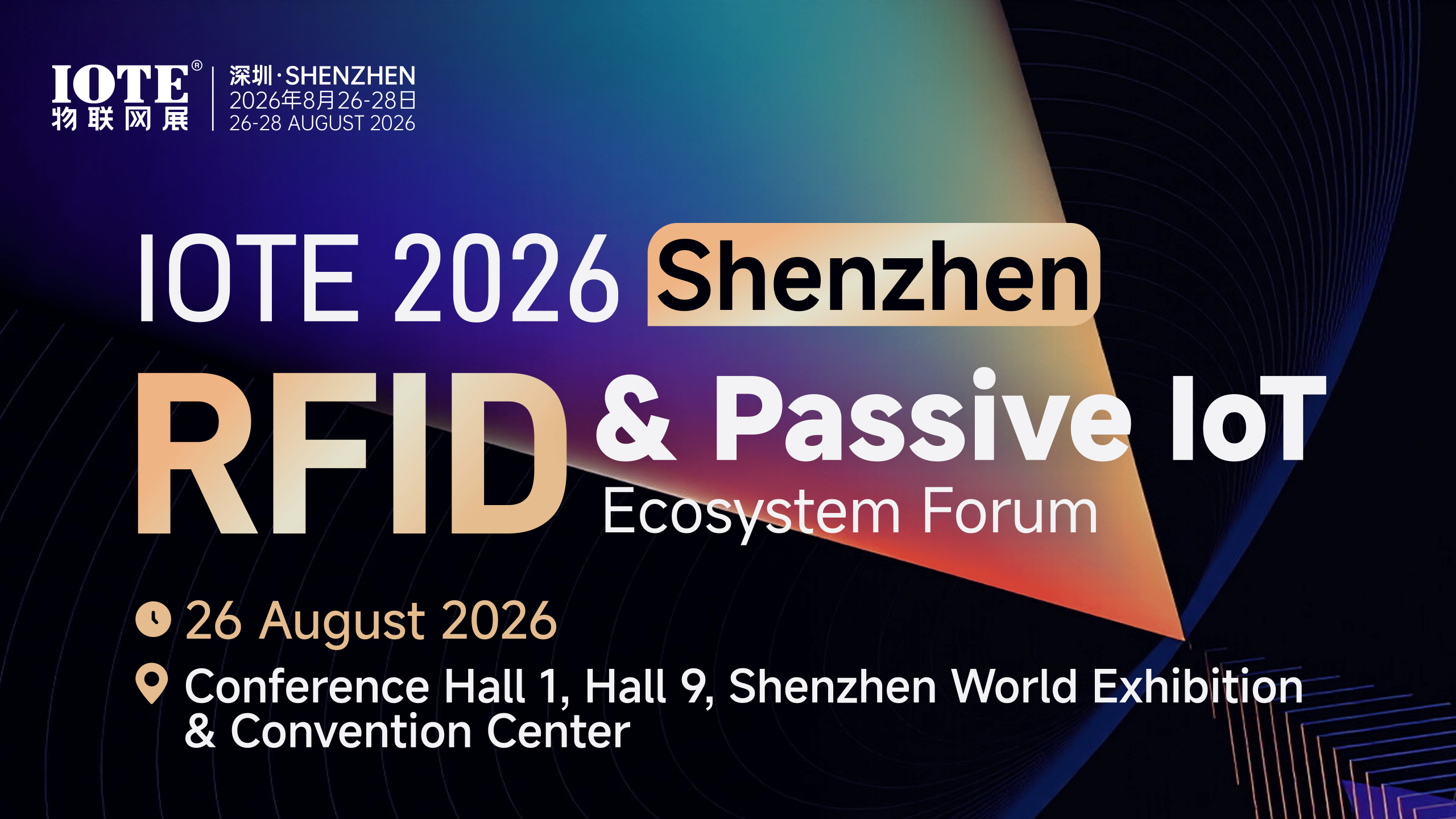 IOTE 2026 Shenzhen • RFID Passive IoT Ecosystem Summit