

Ultra-Wideband (UWB) technology is expanding into new applications in immersive audio. According to a recent report by audioXpress, audio technology company StreamUnlimited has partnered with NXP Semiconductors to develop a reference design that combines UWB-based spatial awareness, adaptive audio rendering and a modular audio platform.
The solution is designed to address some of the key challenges associated with traditional home immersive audio systems, including speaker placement, spatial positioning and system configuration. By removing the need for fixed speaker arrangements, it aims to deliver an optimized surround sound experience with greater flexibility.
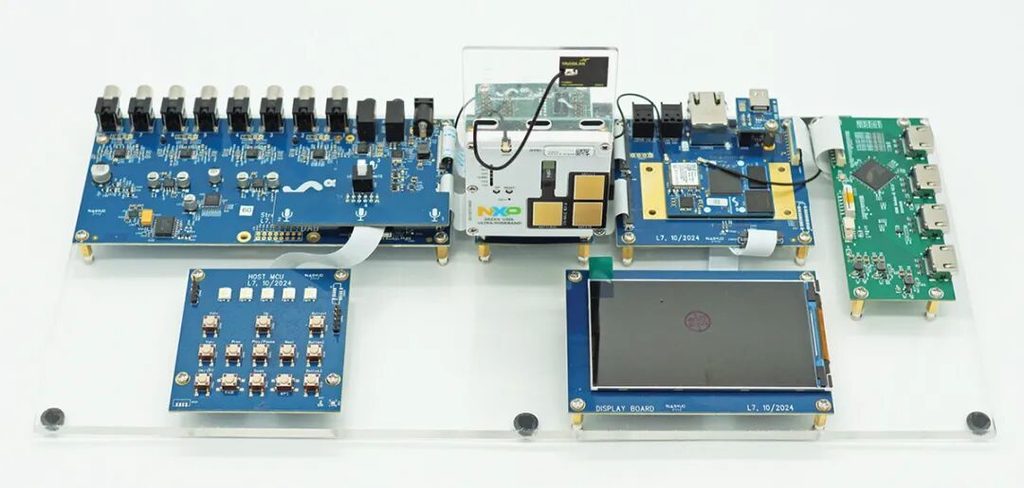
As home audio equipment continues to evolve, the soundbar is increasingly becoming the centerpiece of modern home entertainment systems. Beyond conventional audio playback, demand is growing for support for immersive audio formats such as Dolby Atmos, DTS:X, 360 Reality Audio and MPEG-H.
However, traditional multi-channel audio systems often require speakers to be positioned in specific locations to achieve the intended sound field. The complexity of installation and calibration can make these systems less accessible to everyday users.
To overcome these limitations, adaptive audio rendering technologies such as Dolby Atmos FlexConnect are enabling more flexible speaker configurations. These technologies dynamically adjust audio output according to the actual positions of speakers and listeners.
The joint reference design from StreamUnlimited and NXP takes this concept further by integrating UWB technology. Through precise ranging and spatial awareness, the system can automatically locate speakers and listeners, providing the foundation for more flexible deployment of immersive home audio systems.
UWB-Powered Spatial Awareness and Speaker Positioning
At the heart of the reference design is StreamUnlimited’s Stream1955 module, paired with NXP’s Trimension SR250 UWB chip.
The Stream1955 is a Linux-based embedded audio hardware module powered by an NXP i.MX 8 processor. It supports Wi-Fi 6E, Ethernet, Bluetooth and digital signal processing (DSP), enabling it to handle network audio streaming, multi-channel input and output, and 3D audio decoding.
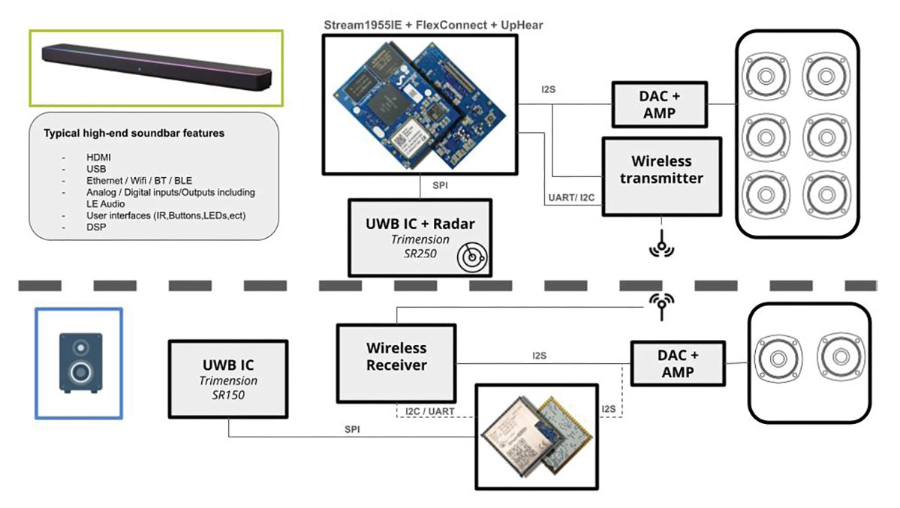
For speaker positioning, each wireless speaker is equipped with an NXP Trimension SR150 UWB transceiver. This allows users to place speakers freely according to their room layout, without having to follow a conventional fixed configuration.
The Trimension SR250 acts as the system’s central coordinator. Using UWB, it measures the distance, angle and height of individual speakers, while its UWB radar capabilities can also detect the listener’s position. Alternatively, a UWB-enabled smartphone can be used to determine the listener’s location through the FiRa protocol stack.
Once spatial positioning data is collected, the system can dynamically adjust audio rendering parameters to reflect the actual room layout. For example, if speakers are placed in different corners of a room or listeners move to another seat, the audio renderer recalculates the output based on the speakers’ real-world positions and the listener’s location, helping optimize the overall sound field.
Another notable feature is the use of Ranging with In-band Data Transfer (RID). This mechanism enables the SR150 modules in individual speakers to measure their relative positions and transmit data directly to the central device over UWB, eliminating the need for a separate control or data transmission channel.
The multi-node positioning architecture also improves reliability in challenging environments. If a speaker cannot be detected directly by the central coordinator, the system can use measurements from other speakers to estimate its position. This provides additional support for positioning in non-line-of-sight (NLOS) conditions.
Flexible Multi-Channel Audio Transmission
The Stream1955 module can deliver up to 12 audio channels. Depending on the product design, manufacturers can connect some channels to local digital-to-analog converters (DACs), while transmitting the remaining channels wirelessly to satellite speakers.
For wireless audio transmission, the system supports Bluetooth Low Energy Audio (LE Audio). However, current Bluetooth implementations still face bandwidth and standards-related limitations when handling multi-channel transmission to more than three wireless speakers. The latency of existing LE Audio implementations is approximately 30 ms.
By comparison, wireless transmission solutions based on WLAN or FSK can reduce latency to around 20 ms while supporting up to eight channels of 48 kHz/24-bit audio.
This flexibility gives manufacturers more options when designing wireless multi-speaker systems, balancing audio performance, transmission requirements and product configuration.
Turning Standalone Wireless Speakers into Part of an Immersive System
Beyond improving speaker positioning and audio rendering, the reference design places strong emphasis on modularity. It enables conventional wireless speakers to be integrated into an immersive home audio system whenever needed.
For example, while watching a movie, users could move a standalone wireless speaker from another room, such as the kitchen or bedroom, into the living room. The main soundbar would then use UWB and FlexConnect technology to automatically identify the newly added speaker, determine its spatial position and adjust audio rendering parameters to accommodate the updated, potentially asymmetrical speaker layout.
At the hardware level, StreamUnlimited also offers the Stream210 module for developing standalone network speakers. It supports Linux, Wi-Fi 6E, Bluetooth LE Audio, as well as analog and I2S digital audio interfaces.
Through dedicated APIs, different devices can be configured to work together and achieve interoperability. This allows a speaker to operate independently during everyday use and join a larger immersive home audio system when required.
UWB Expands Beyond Connectivity into Spatially Adaptive Audio
The joint reference design from StreamUnlimited and NXP demonstrates another promising application for UWB technology in the home audio market.
UWB is moving beyond conventional device connectivity and ranging to support spatial awareness, listener positioning and adaptive control of audio systems. By combining precise positioning capabilities with modular hardware and intelligent audio rendering, the technology makes it possible to create more flexible and user-friendly immersive audio experiences.
As home entertainment systems continue to move towards wireless connectivity, modular architectures and intelligent automation, UWB could become an important enabling technology for flexible speaker placement and spatially adaptive audio experiences.