

On October 15, Midea unveiled a next-generation smart home technology strategy at the China Import and Export Fair (Canton Fair), showcasing two key innovations: fine-grained millimeter-wave (mmWave) radar sensing and control, and its AI-powered M-Station intelligent climate control system.
Combining advanced sensing hardware with AI-driven decision-making, the solution is designed for global markets, delivering adaptive climate control across diverse environmental conditions. It can operate reliably across an exceptionally wide temperature range, from -40°C to 70°C.
In 2026, Midea’s overseas business has already begun translating this technology strategy into tangible commercial growth. In the first half of the year, the company reported overseas revenue of RMB 113.127 billion, up 5.54% year on year. Its own-brand manufacturing (OBM) business accounted for more than 50% of overseas revenue, while overseas revenue growth of approximately 5.5% outpaced domestic growth of 2.1%.
Rather than simply promoting the concept of intelligent sensing infrastructure, Midea has demonstrated its commercial value through overseas business performance—and is now positioning its integrated solution for wider international adoption.
How Sensing Technology Creates Commercial Value: Overseas Markets, Energy Efficiency and Comfort
Midea’s approach to intelligent sensing is notably practical: it focuses on benefits that consumers can directly experience.
At the Canton Fair, the company presented a fundamental shift in traditional air-conditioning control—from a model that simply operates according to preset temperature settings to an intelligent system that senses first and then makes decisions.
Powered by fine-grained mmWave radar, the air conditioner can detect human presence, position and activity in real time.
This enables three key functions:
- Comfort while sitting: Adjust airflow to avoid blowing directly onto people who are sitting still.
- Responsive airflow while moving: Dynamically direct airflow to follow occupants as they move around the room.
- Energy saving when no one is present: Automatically switch to a low-power operating mode when the room is unoccupied.
According to SGS laboratory certification cited by Midea, the AI-powered sensing solution can reduce actual energy consumption by up to 50%, significantly exceeding the typical industry improvement range of 15%–30%.
The energy-saving benefits come from three main mechanisms:
- Dynamic load adjustment: Reducing the need for continuous full-load operation.
- Directional airflow delivery: Minimizing the loss of cooling capacity caused by inefficient air distribution.
- Intelligent operation optimization: Improving start-stop cycles and power consumption profiles.
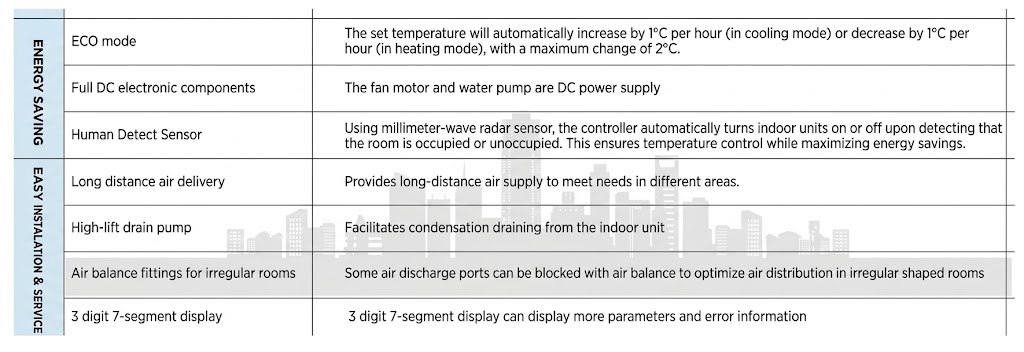
Midea VRF Product Catalogue
For its overseas strategy, Midea also highlighted an important advantage of mmWave radar: unlike camera-based systems, it is a non-imaging sensing technology. By analyzing reflected radar signals, it can estimate human position and movement at centimeter-level spatial resolution without capturing identifiable images.
This makes the technology particularly relevant to European and North American markets, where privacy regulations and consumer expectations around personal data are increasingly stringent.
Midea had already begun integrating mmWave radar into its overseas products as a Human Detect Sensor as early as 2024, laying the groundwork for broader international deployment.
For the Chinese Market: The Third Generation of mmWave Radar
For the domestic market, Midea officially launched its Xingrui FW1 floor-standing air conditioner on September 30, featuring its third-generation mmWave radar technology.
Designed with multigenerational households in mind, the system can simultaneously detect and track one to three people, enabling personalized airflow distribution based on individual comfort preferences.
For example, it can provide gentler airflow for older people who are more sensitive to cold, avoid direct drafts for children, and deliver faster cooling for adults.
The objective is to create a more personalized indoor climate: a cool, comfortable environment without the sensation of direct airflow.
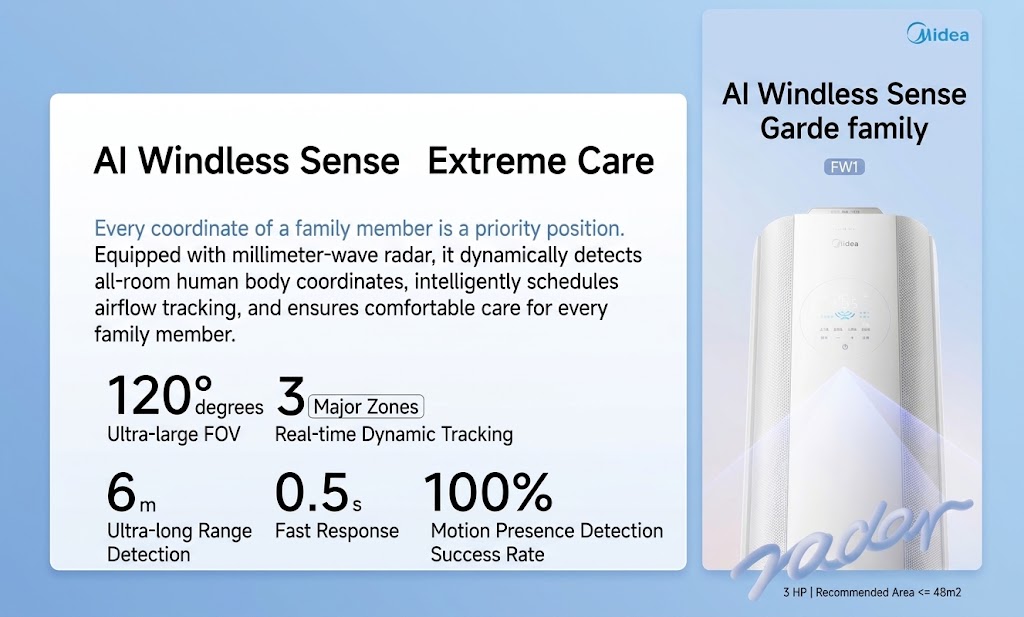
Key Specifications of the Xingrui FW1
According to the product documentation, Midea’s third-generation mmWave radar is based on Frequency-Modulated Continuous Wave (FMCW) technology and operates in the 24 GHz K-band.
It divides a living room into three independently monitored zones—left, center and right—and features:
- 120° field of view
- Detection range of up to 6 meters
- Ability to maintain detection of a stationary person for up to 15 minutes
These capabilities are comparable to the specifications of the ICL1122 chip from Calterah Microelectronics , as referenced in the original technical comparison.
From Early Research to Commercial Deployment: Midea’s mmWave Radar Journey
As a major global home appliance manufacturer with an established product development and market ecosystem, Midea’s progress raises an important question: How long does it take to turn a sensing technology investment into a commercially viable solution?
Midea’s development journey provides a useful example of long-term technology integration and ecosystem collaboration.
- 2019: Midea initiated a project to explore mmWave radar applications in home appliance scenarios.
- 2021: Midea made an exclusive investment in Dianmu Technology (电目科技), which subsequently became a Tier 1 supplier to Midea, collaborating on radar solutions for smart air conditioners.
- 2022: Midea conducted technical discussions with companies including Infineon Technologies and Songyuan Technology (宋元科技), also known as Yunfan Ruida (云帆瑞达).
- 2023: Midea’s Central Research Institute established a joint laboratory for intelligent mmWave radar sensing with Calterah Microelectronics (矽典微), extending cooperation beyond module procurement into chip-level research.
- 2024: Midea moved into product deployment, launching its first air-conditioning indoor unit equipped with intelligent mmWave radar sensing.
- 2026: Midea publicly introduced its M-Station system and fine-grained mmWave radar solution for overseas markets, marking a new step in bringing its integrated intelligent climate-control technology to international customers.
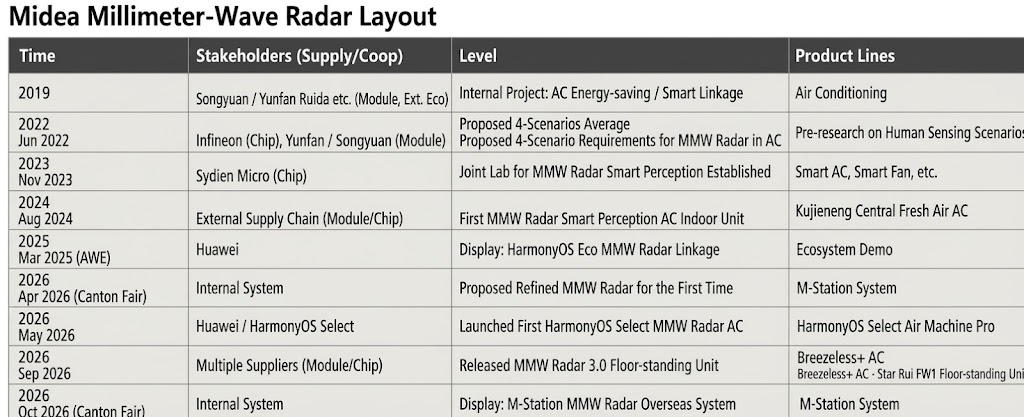
Midea’s development path highlights how sensing technology can evolve from early-stage research and component integration into differentiated products and scalable system solutions.
More broadly, the combination of mmWave radar, edge sensing and AI-driven control points to a significant direction for the smart home industry: moving beyond connected appliances toward devices that can understand their surroundings, respond to human needs and optimize energy use in real time.
As smart home technologies continue to expand globally, intelligent sensing is becoming an increasingly important foundation for more personalized, efficient and privacy-conscious living environments.