In the Czech Republic, an RFID-powered smart fridge solution that operates without cashiers, queues or manual checkout is reshaping how companies provide meals to their employees. The local self-service food service venture Eat Smart has recently secured a significant investment. V-Sharp, an investment group founded by Michal Menšík, founder of Dodo, a leading cold-chain fulfilment provider in Central and Eastern Europe, has acquired a 25% stake in Eat Smart’s operating company, Innovation Lab. The investment will be used entirely to expand its network and replicate the business model across international markets.
Unlike conventional vending machines, Eat Smart has a clear ambition: to use a distributed network of smart refrigerators to replace traditional corporate canteens, which typically rely on significant staffing and operate within fixed meal-service hours at factories and office buildings.
Launched in 2024 by Czech celebrity chef Filip Sajler and food logistics group Hopi Holding, Eat Smart has already deployed more than 100 UHF RFID-enabled smart refrigerators across the Czech Republic, selling approximately 50,000 pre-packaged, RFID-tagged meals every month.
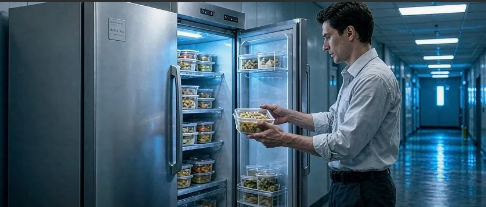
The system combines FEIG readers with dedicated LOCFIELD antennas. Employees simply scan to unlock a refrigerator, select the meals they want and close the door. The system automatically identifies all selected items in bulk and charges the employee immediately, enabling 24/7 self-service food access.
Meal production and cold-chain replenishment are handled by its partner, Hopi Holding. Powered by edge computing and cloud-based inventory management, the system automates stocktaking and provides alerts for products approaching their expiration dates.
In effect, the traditional canteen’s kitchen serving counters and cashier positions are replaced by compact refrigerated units installed in corridors, near production areas and throughout workplaces.
Its corporate customers include DHL, Notino, automotive component manufacturer Witte, as well as Dodo itself. The solution is particularly suitable for shift workers and businesses with flexible working schedules, addressing a common problem: employees who cannot access meals during conventional canteen opening hours.
Logistics Players See Strategic Value in RFID-Powered Corporate Catering
What makes this investment particularly interesting is the involvement of a cold-chain logistics provider in the food service sector. The move reflects growing confidence in the potential of RFID technology to make corporate catering more scalable and efficient.
Traditional corporate canteens operate on a centralized, asset-intensive model. They require dedicated kitchens, chefs, cleaning staff and cashiers, while operating within fixed service hours. When employee shifts are distributed or workforce numbers fluctuate, it becomes difficult to optimize staffing and facility costs, often resulting in underutilized resources.
RFID smart refrigerators, by contrast, offer a lightweight, distributed model. They do not require dedicated kitchens and only need regular cold-chain replenishment. Individual locations can be added or removed flexibly, making the solution particularly suitable for smaller factories, branch offices and workplaces where building a traditional canteen is impractical.
For an on-demand cold-chain logistics provider like Dodo, Eat Smart represents more than a food retail business. It offers a new type of last-mile service endpoint for its existing cold-chain fulfilment network.
Dodo already has established cold-chain delivery capabilities across several Central and Eastern European markets. These capabilities could support Eat Smart’s regional replenishment, food distribution and inventory turnover as the business expands, connecting the entire value chain:
Central Kitchen → Cold-Chain Transportation → Smart Refrigerator Locations → Employee Self-Service
Unlike conventional food delivery, which relies on individual orders and separate deliveries, the smart refrigerator model uses demand forecasting and advance replenishment. Meals are stocked in locations close to consumers before they are needed.
This near-field food service model could deliver significant long-term advantages in unit fulfilment costs. From a logistics perspective, the key opportunity lies in consolidating fragmented employee meal demand into a repeatable B2B cold-chain distribution network with recurring replenishment cycles.
Looking at the global smart catering market, different technology approaches serve different needs.
Many smart canteen solutions in China focus on upgrading existing facilities by installing RFID-based checkout stations within traditional canteens. Eat Smart takes a different approach, focusing on distributed, self-service refrigerator locations.
Its UHF RFID solution supports simultaneous multi-tag reading, making it suitable for identifying multiple meal containers even when they are stacked or partially obstructed. Unlike optical recognition systems, RFID identification is not dependent on lighting conditions. This enables reliable item recognition when multiple employees select meals at the same time.
Each meal container carries a passive RFID tag that can be linked to product information, expiration dates and batch details. This creates a one-item-one-identity system that combines automatic payment processing with food traceability.
RFID Is Opening Up a New Market for Near-Field Corporate Food Services
From an industry perspective, corporate catering worldwide is moving beyond the traditional model of relying exclusively on in-house canteens.
Large industrial parks may continue to operate conventional dining facilities, but smaller factories, businesses with multiple shifts and geographically dispersed offices are increasingly looking for more flexible and efficient food service options.
RFID smart refrigerators address this demand with several operational advantages.
1. Automated Checkout and Lower Operating Costs
The entire checkout process is automated, eliminating the need for dedicated cashiers and reducing the operational and management burden on service providers.
2. Cloud-Based Inventory Management
Real-time inventory data helps supply chain operators forecast demand more accurately, optimize production planning and schedule replenishment more efficiently, improving meal turnover and reducing waste.
3. End-to-End Food Traceability
RFID tags carry traceability information that supports meal record management and food safety monitoring throughout the supply chain.
4. Greater Convenience for Employees
Employees are no longer restricted by fixed canteen meal times. They can access food whenever they need it, providing greater flexibility for shift-based and non-standard working schedules.
5. Easier Deployment and Business Expansion
Standardized equipment and RFID tags make it easier to establish new service locations. The lower deployment requirements also make the business model more adaptable across different regions and industries.
Michal Menšík’s investment ultimately reflects confidence in the combination of cold-chain logistics networks and RFID-enabled frictionless checkout.
This development sends a clear signal about the future of corporate catering. Competition in the sector is gradually shifting away from food quality and physical dining facilities alone, toward proximity-based, automated and digitally managed food supply capabilities.
RFID smart refrigerators are more than self-service food vending equipment. They represent a new generation of distributed infrastructure for corporate catering.
As deployment networks continue to expand, this model could become a mainstream employee dining alternative alongside traditional corporate canteens.