

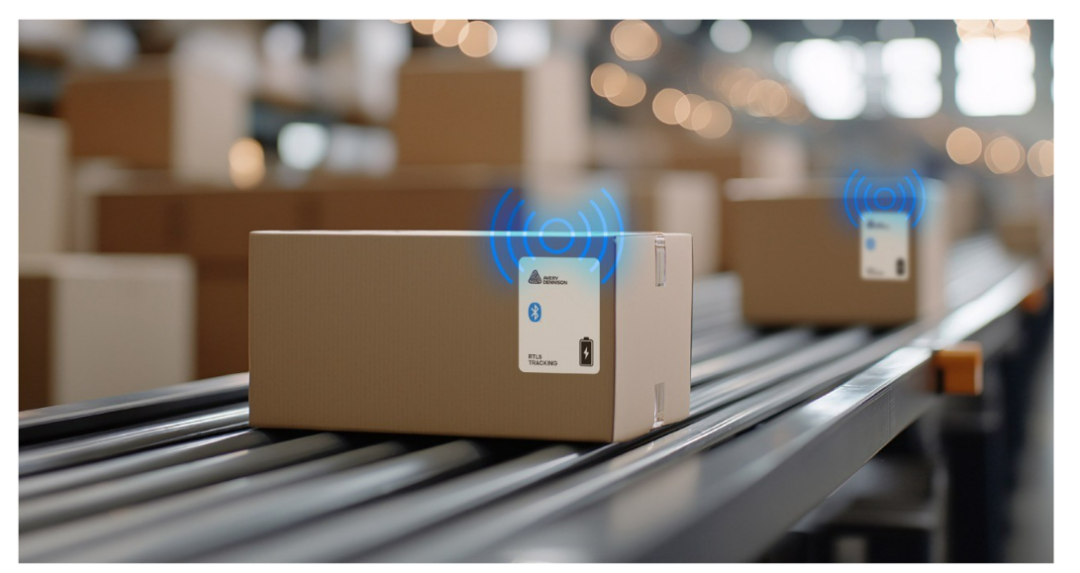
Among the many IoT connectivity technologies available today, Bluetooth is arguably one of the most widely adopted — perhaps even the most widely adopted — technologies of all.
If we look purely at shipment volumes, there are technologies with even larger numbers, such as passive RFID tags. However, in our everyday lives, Bluetooth-enabled products are clearly far more visible than RFID products.
For most people, the passive RFID tags they encounter are mainly product labels attached to clothing. Bluetooth devices, on the other hand, are everywhere: wireless earbuds, smart speakers, TV remote controls, smartwatches and fitness bands, electronic shelf labels, and Bluetooth item-finding tags used at parcel collection points, to name just a few.
In our annual High-Precision Positioning Technology Industry White Paper, UWB and Bluetooth are two of the key technologies we cover. Although we tend to devote more attention to UWB because of its superior performance and specialization in high-precision positioning, the reality is that Bluetooth-based positioning products still ship in significantly higher volumes than UWB-based products.
Take tracking tags, for example. Annual shipments of Bluetooth tags exceed 100 million units, while UWB tag shipments remain in the tens of millions, with Apple’s AirTag accounting for a substantial share. The same pattern can be seen in the digital car key market. Although UWB has been adopted in some high-end vehicle models, Bluetooth-based digital key solutions are clearly much more widely deployed.
Throughout Bluetooth’s evolution, low cost and low power consumption have remained two of its core development priorities. Continued improvements in these areas have made Bluetooth increasingly competitive with passive RFID IoT products in a growing number of applications.
In recent years, the market has also seen the emergence of battery-free chips based on Bluetooth technology. Their operating principle is similar to that of UHF RFID: the tag contains no battery and harvests RF energy from its surrounding environment, including signals emitted by Bluetooth gateways, through its antenna.
The manufacturing process is also similar to that of UHF RFID tags. One key difference is that a passive Bluetooth tag incorporates a capacitor, which stores the small amount of energy harvested from the environment. The stored energy is then used to power the chip.
These products have already entered large-scale commercial deployment. One of the key chip suppliers in this segment is Israeli company Williot. According to market information, a passive Bluetooth tag inlay of this type costs approximately RMB 2–3 per unit. The price of a finished tag may be higher, depending on the packaging process, materials and other specialized manufacturing requirements.
These tags have already achieved shipment volumes in the hundreds of millions of units, demonstrating that the technology has reached a meaningful level of commercial adoption. As production scales up further, prices are expected to decline.
But Bluetooth’s exploration of low-power, low-cost products does not stop there. Recently, we have seen another emerging category of Bluetooth smart tags enter the market.
Unlike passive Bluetooth tags, these new smart tags are still active devices and require a battery. However, their tag structure — or, more specifically, their core inlay — is flexible, much like that of UHF RFID products.
Compared with conventional Bluetooth tags currently available on the market, these products have three notable characteristics.
First, they feature a flexible label design. This allows them to be attached to objects like stickers. Their manufacturing process is also similar to that of UHF RFID labels, with the Bluetooth chip, battery and antenna integrated onto a flexible substrate.
Second, they use thin, flexible printed batteries. Manufactured through a printing process, these batteries are lightweight, thin and flexible, making them particularly suitable for Bluetooth smart tag applications.
Third, the Bluetooth chip must operate at extremely low power levels to support the tag’s compact design and battery requirements.
Recently, global RFID label leader Avery Dennison introduced a product in this category under its AD Visi product line.
According to Avery Dennison, the AD Visi product line is a new series of active Bluetooth Low Energy (BLE) tags. Unlike passive tags, these active Bluetooth tags can transmit continuous signals, providing real-time location data, tamper alerts and status monitoring without requiring manual intervention or dedicated scanning infrastructure.
The first generation consists of two products, both powered by InPlay’s NanoBeacon chips. They use thin, non-lithium printed batteries and support wireless activation. With a thickness of less than 1 mm and a flexible structure, they are designed for direct attachment to parcels, pallets and returnable transport items (RTIs).
The tags operate across a temperature range of -30°C to +60°C and offer a read range of up to 100 metres.
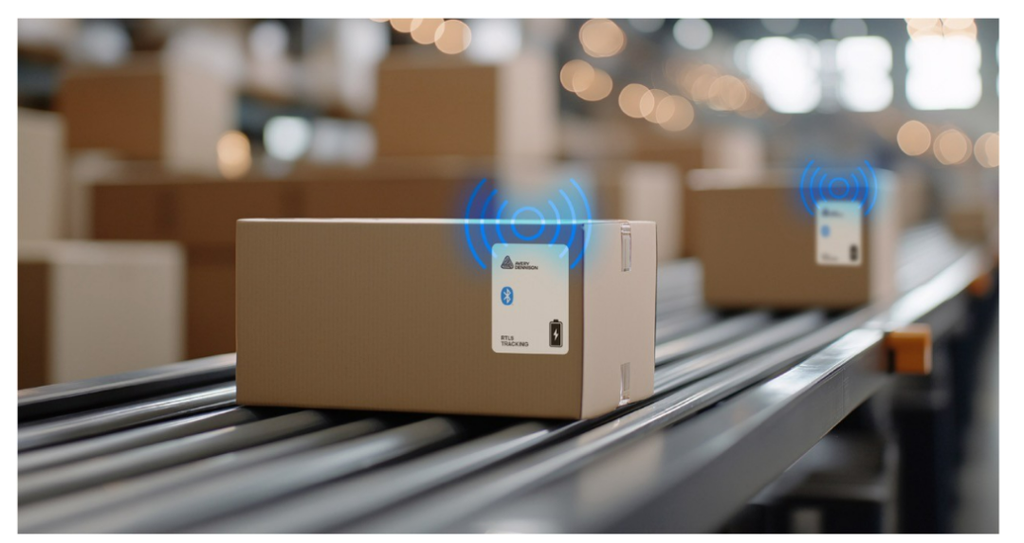
Image source: Avery Dennison official website
We also located a reference technical datasheet for Avery Dennison’s Bluetooth tags, which provides the following specifications:
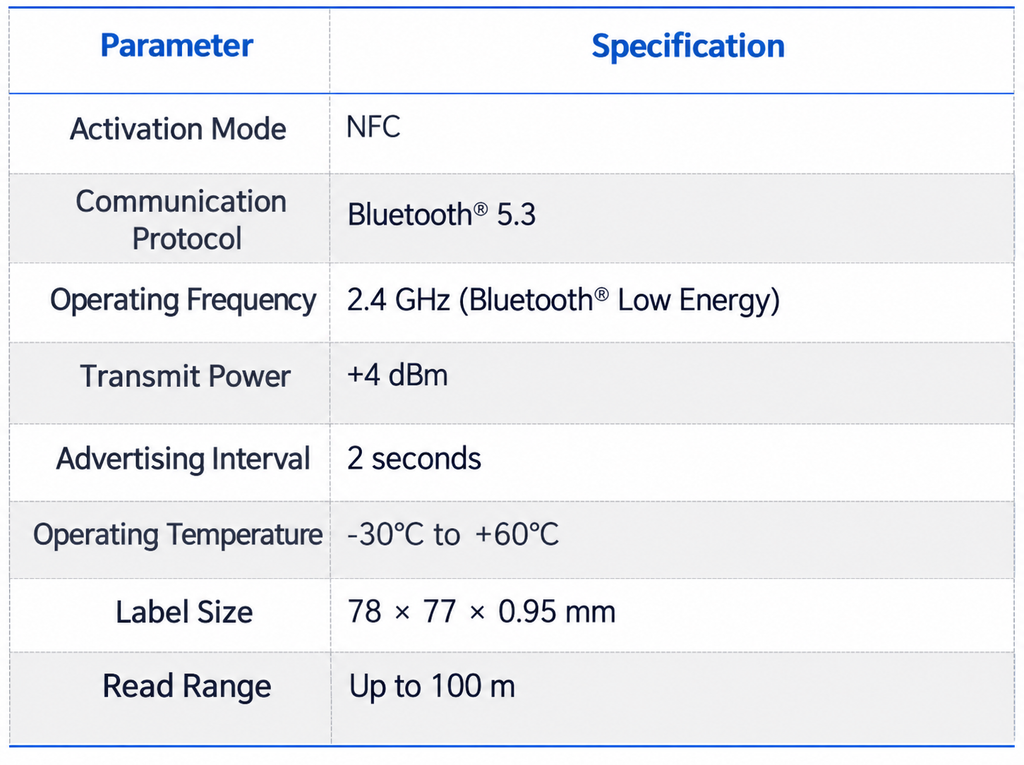
The tags are activated via NFC, a design choice intended primarily to extend their service life.
When tags leave the factory, they need to remain in deep sleep mode. Otherwise, if they start operating immediately after production, they may consume battery power during the potentially several months between manufacturing and actual deployment.
To minimize power consumption, the Bluetooth chip operates in broadcast-only mode and does not receive incoming signals. NFC activation allows the tag to be switched on when it is ready for use.
Some key specifications of InPlay’s NanoBeacon chips are also available from public sources. The NanoBeacon series currently includes two models: the IN100 and IN120.
The series is designed specifically for ultra-low-power and low-cost applications. These chips operate as broadcast-only BLE beacon SoCs, without an MCU. In terms of power consumption, their sleep current can be as low as 650 nA, while average power consumption can reach the sub-microwatt (sub-μW) range. With intermittent advertising, they can operate for years on small-capacity batteries.
These characteristics make NanoBeacon chips particularly well suited to low-cost, flexible printed Bluetooth tag applications.
At present, we have not yet found confirmed pricing information for these new tags. However, we can make a preliminary estimate by comparing them with competing products already available on the market.
As active Bluetooth tags equipped with batteries, they should cost more than Williot’s passive Bluetooth tags, which are priced at approximately RMB 2–3 per unit.
Another useful benchmark is the Bluetooth-enabled audio-visual item-finding tags widely used at parcel collection points. We understand that these products currently cost around RMB 3–5 per unit, although their pricing benefits from annual shipment volumes exceeding 100 million units.
As a global industry leader, Avery Dennison is unlikely to position a newly launched product at an extremely low price before it reaches large-scale production. We therefore estimate that the current price of its AD Visi tags is likely to be above RMB 3–5 per unit, but below RMB 10. Naturally, prices could gradually decline as commercial adoption and production volumes increase.
The potential target markets for these products include several key application areas:
- Pharmaceutical cold chain logistics: biological products, vaccines, cell therapy samples, blood products, in vitro diagnostic reagents and high-value active pharmaceutical ingredients (APIs).
- Pallet and returnable transport item (RTI) management: tracking and managing reusable transport assets throughout the supply chain.
- Food and fresh produce cold chains: monitoring the location and status of temperature-sensitive goods during storage and transportation.
- Manufacturing and component management: tracking critical components and high-value parts within production facilities and supply chains.
In our view, these products have considerable application overlap with passive Bluetooth tags. Williot’s passive Bluetooth tags have reportedly already achieved shipments in the hundreds of millions of units for a single customer, Walmart.
This suggests that the market potential for active Bluetooth smart tags could also reach hundreds of millions, or even billions, of units. Compared with passive alternatives, active tags are expected to offer longer transmission ranges, more frequent broadcasting and better overall system reliability.
The main trade-off is price: active Bluetooth tags are more expensive than passive Bluetooth tags. Ultimately, customers will choose the solution that best matches their budgets and application requirements.
The three technologies can be broadly compared as follows:
- UHF RFID tags: The lowest-cost option, but with a shorter read range. Real-time tracking is more challenging, making them better suited to applications involving fixed reading points.
- Passive Bluetooth tags: A mid-range option in terms of cost, with moderate performance in terms of operating range and system reliability.
- Active Bluetooth tags: The most expensive of the three, but offering the best real-time data availability and overall reliability.
Ultimately, as long as customers have a need to identify, manage and track physical assets, there is likely to be a suitable solution for every application and budget.