
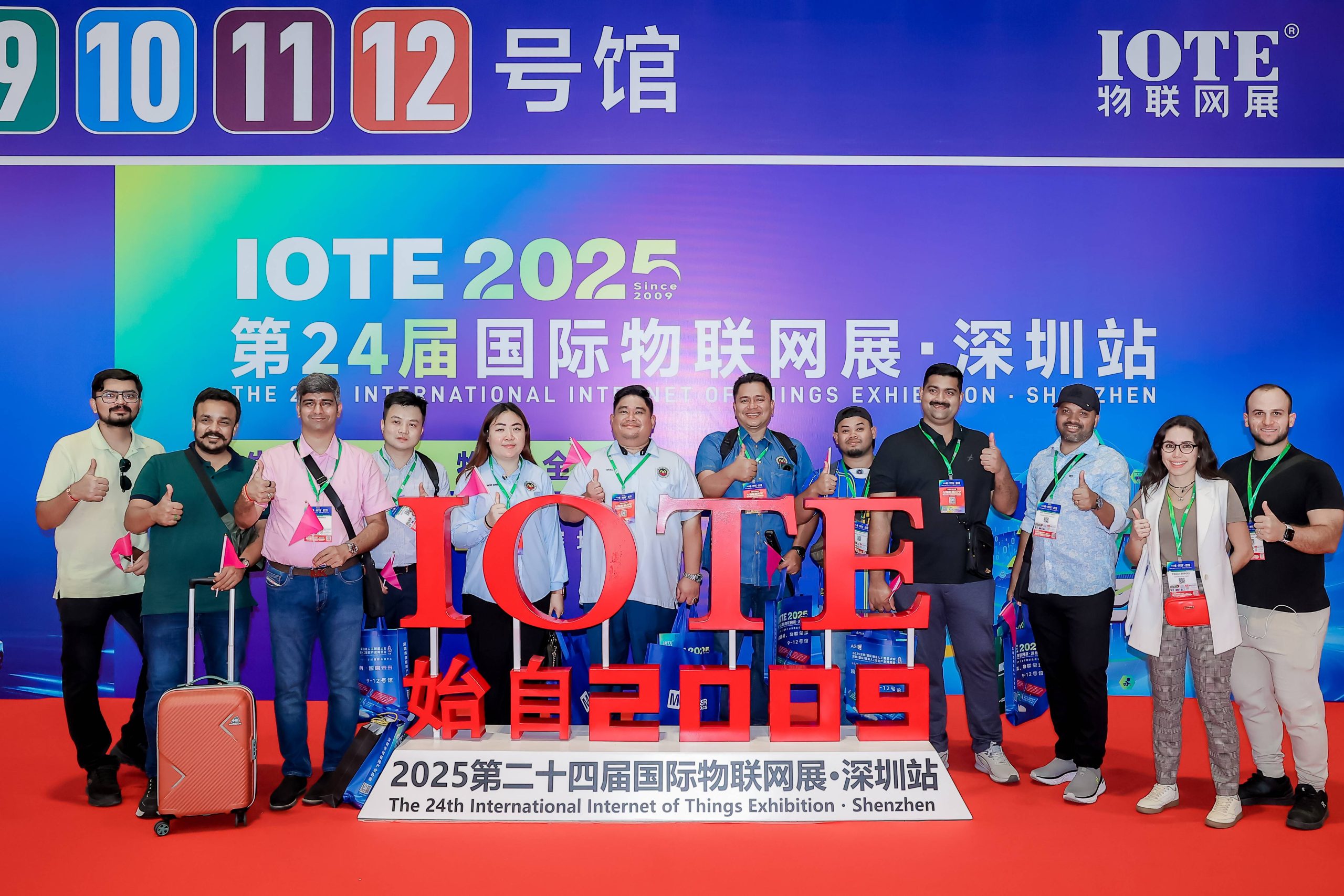
On August 26, during IOTE 2026 Shenzhen, the High-Precision Positioning Technology & Applications Ecosystem Seminar was successfully held. The event brought together key industry representatives from Changsha Chixin Semiconductor Tech Co., Ltd., Maxscend Microelectronics, Knowway Rida, Silicon Labs, and Antennaware, who engaged in in-depth discussions on the latest developments in UWB, Bluetooth positioning, and antenna technologies.


01 Industry Trends: UWB Convergence Gains Momentum, While Smartphone and Automotive Markets Take Diverging Paths
The seminar opened with Zhang Zhongliang, Head of AIoT XingTu Research Institute, who presented the latest 2026 market analysis of China’s high-precision positioning technology industry.
He noted that UWB’s integration of communication and sensing—often referred to as Integrated Sensing and Communication (ISAC)—has moved beyond the conceptual stage and is entering commercial deployment, becoming a key value proposition in the market.
In the automotive sector, UWB digital keys are increasingly being extended to support occupancy/presence detection, kick sensors, and even ultrasonic parking-assistance replacement. However, cost constraints have led to more conservative expectations for market penetration, with adoption expected to remain concentrated in mid- to high-end vehicle models.
In the two-wheeler market, NIU Technologies has taken the lead in mass-producing a solution that combines UWB vehicle keys with blind-spot radar, prompting growing interest and follow-on adoption across the industry.
Progress in the smartphone market has been slower than expected. Huawei has shifted its focus toward NearLink, while Xiaomi’s 17 series reportedly incorporates a Qualcomm-based UWB solution with lower chip costs. However, the adoption outlook among other major smartphone manufacturers, including OPPO and vivo, remains uncertain.
In the consumer IoT market, smart locks and radar-based sensing for applications such as air conditioners are seeing healthy growth, supported by increasing ecosystem alignment. The enterprise market, meanwhile, is facing saturation pressure in policy-driven applications, particularly in sectors such as coal mining and chemical manufacturing.

In the Bluetooth segment, the market for RSSI-based beacons continues to shrink year by year, while Bluetooth Tags compatible with Apple’s Find My network have achieved annual shipments of more than 50 million units. Bluetooth Channel Sounding (CS) is emerging as a competitive technology for applications such as digital keys, although challenges related to power consumption and direction finding remain key barriers to wider adoption.
According to Zhang Zhongliang, the industry is shifting from competition between individual technologies toward the integration of sensing and communication, together with greater ecosystem collaboration. Innovation is accelerating in the mid- to high-end market, while cost-sensitive applications are placing greater emphasis on finding the right balance between practicality, performance, and power consumption.
02 Smart Home Appliance Applications: UWB Radar Sensing Is Transforming the User Experience
Zhou Leilei, Marketing Manager at Changsha Chixin Semiconductor Tech Co., Ltd., shared insights into the full range of UWB applications across the smart home appliance sector. She highlighted how UWB technology is evolving from high-precision positioning to radar-based sensing, opening up new possibilities for smart appliance interaction and redefining the user experience.
With decades of expertise in the UWB field, Chixin Semiconductor has shipped more than 10 million UWB chips to date and has deployed its solutions with dozens of leading customers worldwide.
Zhou explained that UWB radar sensing offers several key advantages, including strong penetration capability, non-line-of-sight detection, and the ability to detect subtle human movements. Its ability to detect stationary human presence is particularly strong compared with 24 GHz and 60 GHz millimeter-wave radar, while its performance is less affected by environmental factors such as lighting conditions, temperature, humidity, and smoke or dust.

03 Comprehensive Digital Key & Sensing Solutions
Ji Te, Senior Marketing Manager of the SoC Product Line at Jiangsu Maxscend Microelectronics Co., Ltd., provided a detailed overview of the company’s “Comprehensive Digital Key & Sensing Solution” portfolio. As a leading domestic provider of RF front-end and wireless SoC solutions, Maxscend is expanding beyond RF front-end technologies toward a comprehensive portfolio of wireless communication and sensing SoCs.
Ji explained that the company has established three major product lines covering BLE 6.0, SLE 2.0 (NearLink), and UWB. Its portfolio includes the MXD2678 single-mode and MXD2680 dual-mode Bluetooth chips, as well as the MXD2710 UWB SoC, providing integrated, end-to-end solutions for applications such as automotive systems and smart locks.
The dual-mode chip enables a seamless upgrade path from Bluetooth to NearLink. Under comparable power consumption, NearLink can deliver data rates up to 6.3 times higher than Bluetooth, extend communication range by 2.4 times, and improve interference resistance by 7 dB through Polar coding. It also expands the number of network nodes from 8 to more than 200.
The UWB chip delivers ±2 cm ranging accuracy and ±2° angle accuracy, while integrating radar sensing capabilities to support applications including kick sensing and sentry monitoring.

The solution covers a broad range of applications, including digital keys, parking radar, in-cabin occupancy detection, and gesture tracking. Its Blind Spot Detection (BSD) radar can reliably detect two targets at distances of up to 40 meters, delivering performance beyond that of conventional 24 GHz solutions.
Leveraging its Chipsea IDM platform, Maxscend has established an integrated in-house development capability spanning the entire chain from materials and wafer fabrication to packaging and testing. The company also provides a comprehensive SDK covering the full stack from the physical layer to the application layer, with support for China’s commercial cryptographic algorithms (Guomi). This enables customers to accelerate the development of differentiated products and solutions.
Looking ahead, Maxscend will continue to expand innovative UWB applications across smart automotive and IoT markets, driving the next generation of sensing and interactive experiences.
04 UWB Integrated Sensing and Communication: From Ecosystem to Chip
Li Yu, CTO of Chengdu Knowway Rida Technology Co., Ltd., introduced the company’s KN01 Integrated Sensing and Communication 2.0 SiP, highlighting the latest evolution of its UWB technology strategy.
He noted that the UWB industry is shifting from a chip-centric model toward a solution-provider-driven ecosystem. Standard UWB chips are increasingly unable to address the highly diverse requirements of next-generation 2.0 applications. To bridge this gap, Knowway Rida is developing scenario-specific SiP solutions tailored to the needs of individual application scenarios.

The KN01 Integrated Sensing and Communication 2.0 SiP integrates UWB, BLE, antenna, and IMU into a highly integrated package, enabling SMT-ready deployment and supporting four key application domains: automotive, two-wheelers, smart home, and robotics.
In the automotive sector, the automotive-grade KN01 solution supports multiple functions—including digital keys, Child Presence Detection (CPD), kick sensing, sentry monitoring, and parking radar—on a single chip through firmware reuse, delivering overall cost savings of more than 50%.
For two-wheelers, the solution combines UWB and BLE to replace 77 GHz millimeter-wave radar, integrating keyless access, Blind Spot Detection (BSD) radar, and sentry monitoring into a single solution while reducing costs by approximately 50%.
In the smart home, the compact system supports directional remote control and radar-based sensing. For robotics, the solution enables 360° human following and radar-based obstacle avoidance, without relying on lighting conditions and without cumulative positioning errors.
Knowway Rida positions itself around continuously defining scenario-specific capabilities and developing integrated hardware and software solutions. Through a unified SDK and algorithm library, the company aims to design each chip around a specific application scenario, accelerating the adoption of UWB-based integrated sensing and communication as a mainstream sensing technology for intelligent devices and embodied AI systems.
05 Multiple Bluetooth Positioning Technologies with AI-Enabled Edge Intelligence
Huang Liangjun, Senior Field Application Engineer at Silicon Labs, provided a comprehensive overview of the evolution of Bluetooth positioning technologies and the growing integration of AI-enabled edge intelligence.
He noted that Bluetooth positioning has evolved from coarse-grained RSSI-based solutions toward a new era centered on Bluetooth 6.0 Channel Sounding. By combining Phase-Based Ranging (PBR) with Round-Trip Time (RTT) measurements, Channel Sounding can achieve sub-meter positioning accuracy even in non-line-of-sight (NLOS) environments, with reported accuracy of less than 1.5 m in NLOS conditions and less than 0.5 m in line-of-sight (LOS) environments.
The technology also supports multi-antenna switching and frequency-hopping mechanisms, significantly enhancing security, robustness, and resistance to interference.

Silicon Labs’ BG24 and MG24 SoCs integrate dedicated AI/ML hardware accelerators, delivering up to 8× faster inference performance while reducing power consumption by up to 6×, enabling a new generation of edge-intelligent positioning applications.
In collaboration with Unikie, Silicon Labs has developed a Tire Pressure Monitoring System (TPMS) that combines Bluetooth positioning with machine learning algorithms to automatically identify the location of individual tires. Meanwhile, Emanate Wireless’ clinical-grade Real-Time Location System (RTLS) has been deployed in hospital environments, demonstrating the potential of Bluetooth-based positioning in healthcare applications.
Huang emphasized that the deeper integration of AI and Bluetooth positioning is driving RTLS beyond simply “knowing where something is” toward intelligent sensing and contextual awareness. This convergence is enabling higher-precision, lower-power experiences across applications such as digital keys, indoor navigation, and asset tracking.
06 Wireless Antenna Innovation for Wearable Devices: How to Double Transmission Range While Halving Power Consumption
Dr. Matthew Magill, CTO and Co-Founder of Antennaware, highlighted three major challenges that wearable-device antennas face when operating on the human body: resonant frequency detuning, a significant drop in radiation efficiency, and signal blockage caused by the body.
According to his presentation, real-world measurements show that antenna performance can degrade by 10–20 dB compared with nominal laboratory specifications. Testing has also shown that when a standard antenna is worn against the chest, its resonant frequency can shift significantly depending on the wearer’s body shape, while total radiation efficiency can fall to as low as 5–50%.
At frequencies above 6 GHz, signal attenuation and shadowing caused by the human body can become particularly significant, creating substantial coverage gaps and posing additional challenges for reliable wireless connectivity in wearable applications.

To address these challenges, Antennaware has introduced its BodyWave™ surface-wave antenna technology. By exciting surface waves that propagate along the human body, the technology redirects energy around shadowed areas, enabling stable impedance matching and more predictable radiation efficiency.
At 2.4 GHz, BodyWave™ delivers a 10–20 dB improvement in forward-path gain compared with conventional PIFA and chip antennas, potentially doubling the effective communication range or reducing transmit power to approximately one-quarter of the original level.
The technology has been validated in applications including Catapult’s interscapular sports-tracking devices, Hollyland’s full-duplex wireless headsets, and Raycom’s Sub-GHz telemetry solutions, demonstrating significant improvements in the stability of non-line-of-sight (NLOS) connectivity.
Antennaware provides chip-level antenna solutions and reference designs that can be rapidly integrated with existing SoC platforms, helping wearable-device manufacturers achieve more reliable wireless connectivity under real-world, on-body operating conditions.
From UWB integrated sensing and communication and Bluetooth Channel Sounding, to scenario-specific SiP solutions, AI-enabled edge intelligence, and innovations at the antenna level, the seminar highlighted both the technological depth and the breadth of the ecosystem underpinning the high-precision positioning industry.
Speakers broadly agreed that positioning technology is evolving from simply “knowing where something is” toward the integration of communication, sensing, and intelligent computing. The ability to define application scenarios and optimize hardware and software as an integrated system is expected to become increasingly important in the next stage of industry development.
With the 4ab standard moving toward finalization, continued reductions in chip costs, and AI computing capabilities increasingly moving to the edge, high-precision positioning is positioned to expand into a broader range of consumer and industrial applications over the next five years, potentially becoming a foundational spatiotemporal infrastructure for the intelligent world.