

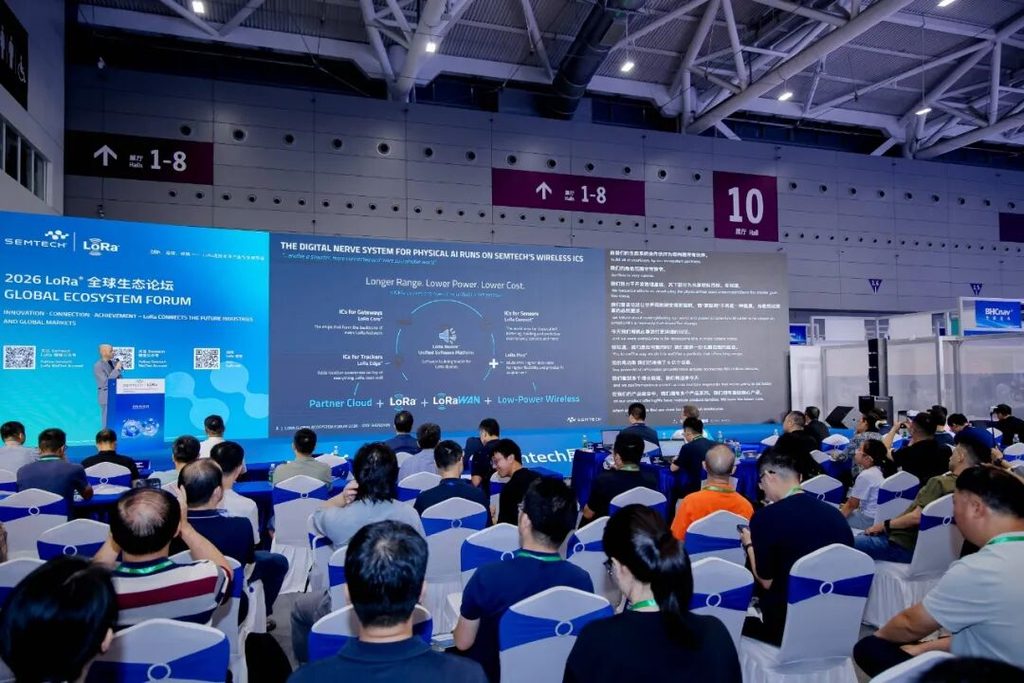
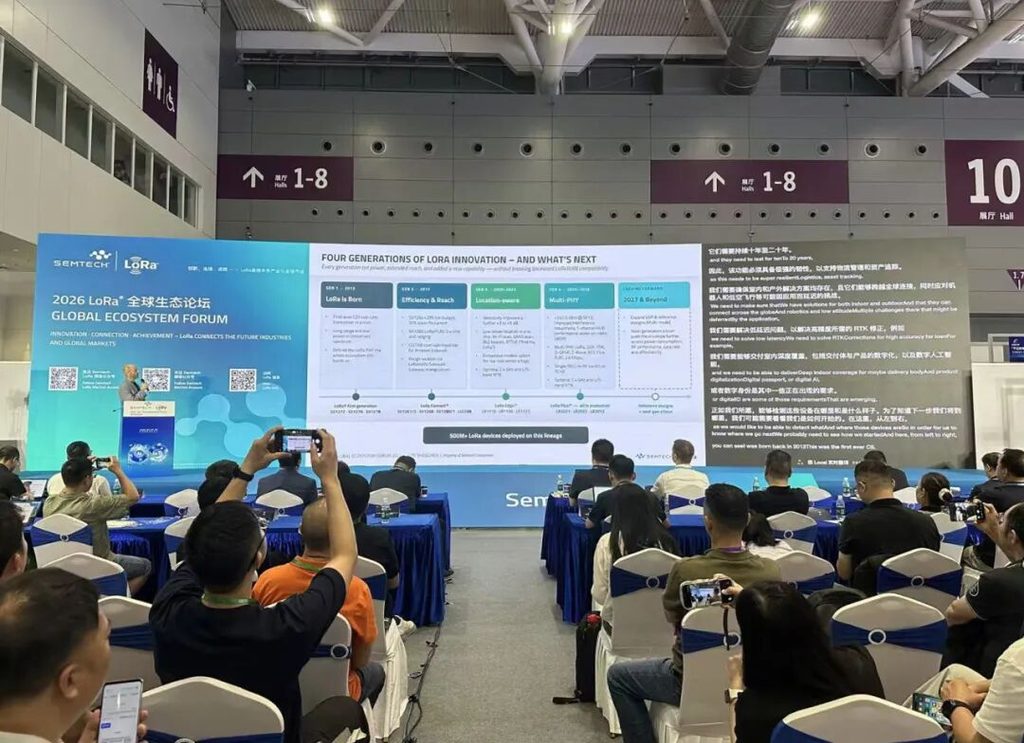
On August 27, the 2026 LoRa® Global Ecosystem Forum concluded successfully at the Shenzhen World Exhibition & Convention Center (Bao’an).
Hosted by Semtech and supported by the LoRa Alliance®, the forum was themed “LoRa Connects Future Industries and Global Markets.” It brought together leading companies and industry experts from across the global LoRa ecosystem, spanning chips, modules, gateways, cloud platforms, and IoT applications.
The discussions focused on the evolution of LoRa technology, ecosystem development, terrestrial-satellite integration, edge AI, and global market expansion, highlighting new opportunities for low-power wide-area IoT and demonstrating how the LoRa ecosystem is evolving to address increasingly diverse connectivity requirements.
The event brought together key players across the global LoRa ecosystem, including the LoRa Alliance, Amazon, Quectel, Lierda, Ai-Thinker, Milesight, Seeed Studio, and Beijing Guodian Hi-Tech Technology, covering the full LoRa value chain from core chips and communication modules to smart gateways, industry solutions, and cloud services.
Speakers explored technology innovation, real-world deployment, ecosystem collaboration, and international market expansion, sharing new technologies and large-scale deployment cases while building greater consensus around the future development of the global LoRa ecosystem.
A New Generation of LoRa Connectivity
One of the key highlights of the forum was Semtech’s announcement that its fourth-generation LoRa chips had entered full-scale production.
The newly launched LR2022 and LR2012 transceivers expand the LoRa Plus™ platform into a broader range of applications, including high-speed data transmission, AI-enabled vision, long-range connectivity, satellite communications, and multi-protocol applications. Semtech’s LoRa Plus portfolio now includes three production-ready fourth-generation transceivers: LR2021, LR2022, and LR2012.
The LR2022 is designed for global terrestrial and non-terrestrial network connectivity, supporting multi-band operation and enabling integrated communication between terrestrial LoRaWAN networks and satellite backhaul.
This makes it particularly relevant to IoT deployments in environments without conventional public-network coverage, including mines, oceans, deserts, and polar regions.
The LR2012, meanwhile, is optimized for cost-sensitive sub-GHz applications and high-volume low-power endpoints. By helping reduce device bill-of-materials costs, it is positioned for applications such as smart metering, environmental monitoring, and smart-city infrastructure.
Together with the previously introduced LR2021, the fourth-generation LoRa portfolio now covers a broad range of IoT requirements, from cost-sensitive low-power sensing to multi-band connectivity and edge AI applications. The platform also supports multiple wireless protocols and higher-speed data transmission, enabling a wider range of applications from a common hardware and software architecture.
From Long-Range Sensing to Intelligent Security
Mike Wong, Vice President of Sales, APAC Region at Semtech, highlighted the growing role of LoRa in the security industry.
Before the introduction of fourth-generation LoRa IP, security sensors primarily leveraged LoRa’s long range, low power consumption, and robust connectivity to notify management when an abnormal event occurred.
With LoRa Plus™, however, the technology retains these core advantages while adding high-speed FLRC connectivity, with data rates of up to 2.6 Mbps on the LR2021. This opens the door to new capabilities such as audio and image transmission, allowing security teams to gain a much clearer understanding of what is happening in the field.
Combined with edge AI, these capabilities can enable systems to recognize events such as gunshots, breaking glass, or calls for help. Cameras can also be used to identify relevant visual information and transmit key insights to security personnel.
This represents a broader shift in the role of low-power wireless connectivity: from simply reporting that an event has occurred to helping intelligent systems understand what is actually happening.
Three Strategic Directions for the LoRa Ecosystem
Beyond chip innovation, the forum identified three major directions for the future development of the LoRa ecosystem.
1. Integrated Terrestrial-Satellite IoT Connectivity
Satellite connectivity can complement terrestrial networks in areas where conventional infrastructure is unavailable or difficult to deploy.
By combining terrestrial LoRaWAN networks with satellite backhaul, the ecosystem can extend IoT connectivity to remote and hard-to-reach environments, supporting applications such as asset monitoring, resource exploration, and emergency response.
The LR2022’s multi-band architecture is designed specifically to support global terrestrial and non-terrestrial network deployments.
2. Deeper Integration of Edge AI and LoRaWAN
The combination of edge AI and LoRaWAN is creating new possibilities for intelligent sensing at the network edge.
Rather than transmitting every piece of raw data to the cloud, sensor devices can increasingly perform local recognition, data analysis, and anomaly detection, transmitting only key events and relevant features.
This can reduce communication overhead and power consumption while supporting applications that require timely decisions, including predictive maintenance, smart buildings, and intelligent security.
This trend also aligns with the broader development of Physical AI, in which intelligent systems increasingly need to perceive and respond to conditions in the physical world.
3. Global Ecosystem Collaboration and International Market Expansion
The global scale of the LoRa ecosystem provides IoT companies with new opportunities to expand beyond their domestic markets.
With more than 400 core members in the LoRa Alliance ecosystem and compatibility with global networks and platforms such as Amazon Sidewalk, LoRa provides an established ecosystem through which modules, devices, and IoT solutions can reach international markets.
The focus is increasingly shifting from simply exporting individual products to building standardized, ecosystem-based pathways for global deployment.
LoRaWAN Deployment Surpasses 125 Million Devices
The forum also revealed the latest figures from the global LoRa industry.
By the end of 2025, more than 125 million LoRaWAN end devices had been deployed worldwide.
Smart metering, smart cities, and industrial IoT remain among the core application areas, while emerging markets such as smart agriculture, low-altitude inspection, and satellite-based asset tracking are growing rapidly.
This development signals a broader transition for the LoRa ecosystem—from the initial phase of network deployment toward a new stage focused on deeper value creation, application specialization, and intelligent upgrades.
Industry experts at the forum noted that competition in IoT is increasingly moving beyond connectivity technologies alone toward an integrated combination of connectivity, computing, and intelligence.
LoRa is therefore evolving beyond its traditional role as a low-power communication technology. It is increasingly becoming an infrastructure layer for AI-enabled sensing, data acquisition, and pervasive connectivity across the physical world.
Its integration with emerging applications such as intelligent IoT systems and unmanned aerial vehicles is further expanding the scope of LoRa technology and diversifying the ecosystem.
Global Experts Discuss the Next Stage of LoRa Innovation
The forum brought together key figures from across the global LoRa ecosystem.
Mike Wong, Vice President of Sales, APAC Region at Semtech; Shahar Feldman, Senior Product Marketing Director for Wireless ICs at Semtech; and Henry Huang, Vice Chairman of the Board of the LoRa Alliance, participated in media interviews during the event.
They shared their perspectives on LoRa technology evolution, global ecosystem development, satellite integration, and emerging opportunities across new industries.
LoRa Beyond the LoRaWAN Standard
In response to a question about how LoRa could contribute to the development of the low-altitude economy, Shahar Feldman emphasized that the application of LoRa technology extends well beyond the LoRaWAN standard itself.
With global LoRaWAN connections already exceeding 125 million and continuing to move toward the 500-million scale, open-source communities are also exploring new applications by leveraging the long range, low power consumption, and interference resilience of LoRa chips.
The drone industry provides a particularly interesting example.
The open-source, multi-protocol ExpressLRS (ELRS) ecosystem has used LoRa-based technology since the first generation of LoRa chips and has now evolved through multiple generations. It has become particularly relevant to FPV racing drones and other applications where ultra-low latency and strong resistance to interference are critical.
Feldman also pointed out that many drone applications and other emerging use cases require mesh networking capabilities. Open-source communities have therefore become an increasingly important force in exploring new ways to use LoRa hardware.
As he noted, developers are finding ways to use these transceivers in applications that even the original technology developers may not have anticipated.
LoRa and FPV Drones: A New Connectivity Opportunity for the Low-Altitude Economy
One representative case highlighted at the forum involved a Shenzhen-based company that uses LoRa technology in FPV first-person-view racing drones.
Compared with conventional consumer drones, FPV racing drones have much more demanding communication requirements, particularly when it comes to latency.
LoRa’s characteristics can provide an advantage in increasingly congested wireless environments. In the 2.4 GHz band, where many wireless devices compete for spectrum, LoRa-based communication can provide a robust and interference-resistant control link for precise drone operation.
The company’s compact racing drones have already reached international markets.
The case illustrates a distinctive opportunity for LoRa in the low-altitude economy. Rather than attempting to replace Wi-Fi simply by offering longer range, LoRa can provide a stable and interference-resistant control link in complex electromagnetic environments, opening up new possibilities for UAVs and other low-altitude applications.
Connecting the Next Generation of IoT
The successful 2026 LoRa Global Ecosystem Forum not only showcased the latest advances in LoRa technology and its commercialization, but also mapped out new pathways for integrating low-power IoT with satellite communications, edge AI, and global applications.
With fourth-generation LoRa chips now entering full-scale production and the global ecosystem continuing to expand, LoRa is positioned to move beyond traditional connectivity boundaries and unlock new value across industrial IoT, digital cities, pervasive intelligence, and the low-altitude economy.
As connectivity becomes increasingly intertwined with sensing, computing, and AI, the evolution of LoRa demonstrates how low-power wireless technologies can continue to adapt to new application requirements.
The next phase of the LoRa ecosystem will be defined not only by how far devices can connect, but by how intelligently they can connect, communicate, and respond—providing a stronger connectivity foundation for the continued development of the global AIoT industry.