

The UK’s Competition and Markets Authority (CMA) has unveiled new regulatory proposals aimed at significantly reducing the fees Apple charges for access to the iPhone’s NFC contactless payment capabilities. The proposals also seek to ease Apple’s long-standing restrictions on NFC access, allowing UK fintech companies to develop independent contactless digital wallets for iOS.
The move could break Apple Pay’s dominant position in the UK’s in-store NFC payment market, marking another major regulatory intervention targeting the payment ecosystems of major technology platforms, following the European Union’s Digital Markets Act (DMA).
The proposed changes could have significant implications for payment providers, merchants and consumers alike.
High Fees and a Closed Ecosystem Are Holding Back Competition
In its announcement, the CMA highlighted Apple’s high access fees and restrictive terms for third-party NFC payment services as major barriers to innovation in the UK’s digital wallet market.
Although Apple has already opened up certain NFC interfaces to third parties, the high costs of access have made it difficult for most fintech companies and banks to commercialize their own digital wallet solutions. As a result, few independent NFC payment services capable of directly competing with Apple Pay have emerged on iOS.
Unlike the Android ecosystem, where NFC access is generally more open, Apple’s iPhone NFC capabilities have historically remained under its control, with the Secure Element (SE) closely integrated into the Apple Wallet ecosystem.
Third-party providers seeking to offer contactless in-store payments on iPhones have therefore had to pay Apple associated service fees.
The CMA has received substantial feedback from financial institutions, indicating that these costs can ultimately be passed on to card issuers, putting pressure on banks’ profit margins. Some of the additional costs may also be indirectly passed on to merchants.
Importantly, the latest proposal does not establish a fixed cap on NFC access fees. Instead, the CMA plans to introduce a set of fair and reasonable pricing principles, requiring Apple to base its fees on costs and a reasonable return.
The objective is to bring the new fees significantly below current levels while allowing Apple to earn a reasonable return, rather than requiring it to provide NFC access entirely free of charge.
The proposals also include measures to remove certain restrictive contractual terms. Apple would be prohibited from preventing third-party wallet providers from presenting and promoting alternative payment options to users.
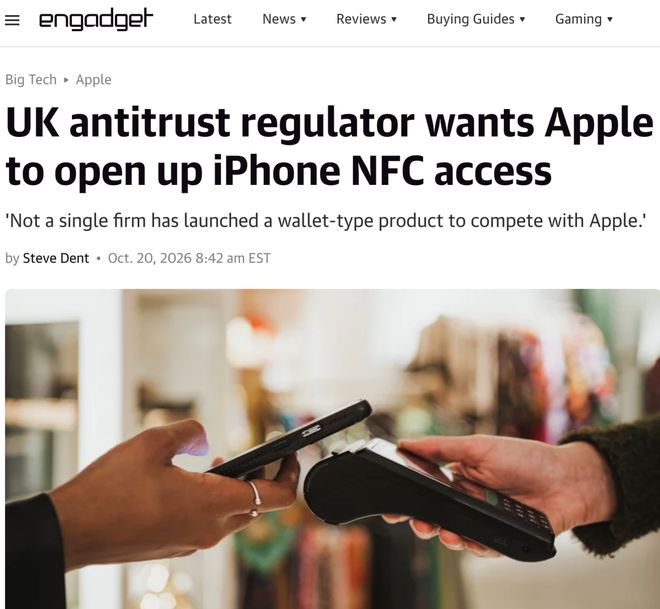
UK Payment Market Could Be Heading for a Major Shift
The proposals have prompted mixed reactions across the market, although the UK’s domestic fintech sector has generally welcomed the move.
The UK is one of Europe’s leading fintech hubs, home to a large number of digital banks and payment service providers. However, restrictions on iPhone NFC access have limited their ability to compete in physical retail environments, leaving many providers focused primarily on online payment services.
If lower fees and broader NFC access are implemented, independent digital wallets could finally gain a stronger foothold on iOS.
This would give consumers more payment choices and potentially accelerate the adoption of other NFC-based applications, including open banking services and digital identity solutions, extending the technology’s role beyond conventional contactless payments.
Apple, meanwhile, faces considerable pressure. NFC payment fees represent one source of revenue within its broader ecosystem. Lower fees and more open access could reduce this revenue while exposing Apple Pay to more direct competition from third-party wallet providers.
Apple has already introduced changes to NFC access in the European Economic Area (EEA) in response to the EU’s Digital Markets Act, allowing third-party payment providers to access NFC functionality and users to select alternative default wallet applications.
Following Brexit, the UK is now pursuing its own regulatory approach, creating an additional layer of scrutiny over Apple’s payment ecosystem.
For merchants and consumers, the long-term outlook could be more favorable.
Greater competition could help reduce costs across the payment value chain, potentially putting downward pressure on merchant payment processing fees. Consumers, meanwhile, could gain the freedom to choose wallets offered by their banks or fintech providers rather than relying primarily on Apple Pay.
However, the proposals are still at the consultation stage. The CMA will collect feedback from the public and businesses before reaching a final binding decision. Apple will also have the opportunity to respond, meaning the implementation timeline remains uncertain.
A Global Regulatory Trend Toward More Open Mobile Payment Ecosystems
Looking at the broader international landscape, regulators in Europe and elsewhere are increasingly challenging closed NFC access and payment ecosystems controlled by smartphone manufacturers.
The UK’s latest proposal is not only an effort to support domestic fintech innovation, but also another challenge to the so-called “walled garden” model adopted by major technology platforms.
If implemented, the changes could reshape the UK’s contactless payment landscape and provide an important regulatory reference point for other countries and regions considering how to govern mobile payment ecosystems.
Ultimately, the issue goes beyond Apple’s NFC fees. It reflects a wider debate over who controls access to essential mobile technologies, how competition should work in digital payment markets, and how innovation can flourish in an increasingly connected economy.