
On August 27, 2026, the AI Hard-Tech Innovation Project Showcase, themed “Human-Robot Collaboration, Shaping the Future of the Greater Bay Area,” was successfully held at Turing Hall, Hall 12, Shenzhen World Exhibition & Convention Center (Bao’an). As a major featured event of the 2026 AGIC Shenzhen International General Artificial Intelligence Conference and GERX Global Embodied Intelligence Robotics Expo, the showcase brought together leading experts and academics, major industry players, prominent investment institutions, and innovative technology startups.
The event highlighted cutting-edge developments in embodied intelligence, service and specialized robotics, AI hardware R&D, and industrial AI applications. It provided a collaborative platform for technology demonstrations, industry dialogue, business matchmaking, and investment opportunities.
Organized by the Shenzhen Artificial Intelligence Industry Association, the showcase invited AI hard-tech startups from across China to present their innovations. It focused on four key areas: embodied intelligence and robotics, general-purpose foundation models and AI agents, underlying hardware innovation, and real-world AI applications.
Projects were selected based on technological strength, differentiated innovation, and practical commercialization potential. Priority was given to companies with proprietary core technologies, working prototypes, and pilot deployment experience. Moving beyond the conventional pitch format, the event offered startups a professional platform to showcase their innovations and connect with valuable industry resources.
Building an Innovation Ecosystem for AI Hard-Tech Startups
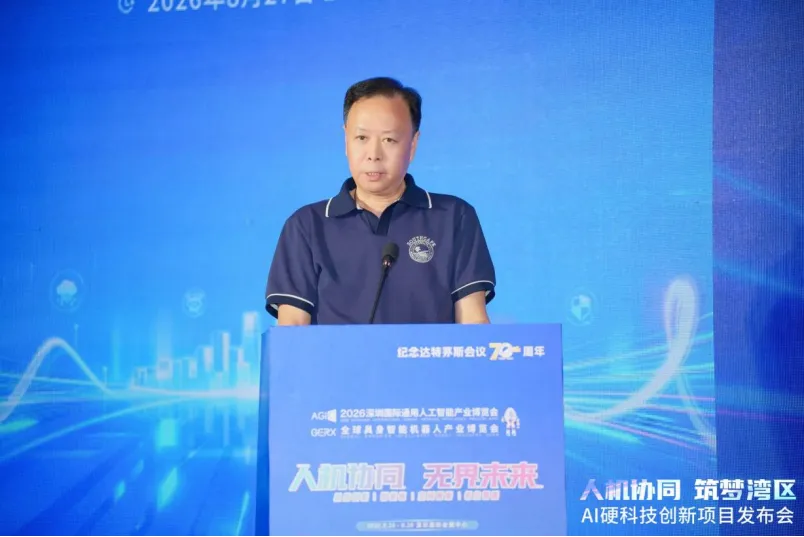
Qiu Shanqin, Honorary President of the Shenzhen Artificial Intelligence Industry Association and CEO of Shenzhen Senior Technology Material Co., Ltd., attended the event and delivered opening remarks.
He noted that the AI industry is evolving rapidly, with innovation moving beyond virtual algorithms into real-world physical applications. Hard-tech startups, he emphasized, are an important driving force behind AI innovation and the commercialization of emerging technologies.
With its comprehensive intelligent hardware manufacturing supply chain and diverse application scenarios, Shenzhen has become a major hub for AI hard-tech innovation and entrepreneurship in China.
Qiu also highlighted the association’s role in connecting research institutions, upstream and downstream industry partners, capital markets, and supply chain resources. The association will continue supporting local technology startups in overcoming commercialization challenges and establishing a stronger presence in the Greater Bay Area.
He also called on investment institutions to pay greater attention to emerging hard-tech startups and specialized AI sectors, working together to build an open, collaborative, and mutually beneficial AI innovation ecosystem across the Greater Bay Area.
The showcase featured two major presentation tracks:
- Technology Paradigm Innovation: AI Hardware Applications in Industrial and Consumer Markets
- Expanding Application Frontiers: Specialized Robotics and Investment Perspectives
More than ten innovative companies from across China took the stage, each delivering a 15-minute presentation on proprietary technologies, R&D breakthroughs, commercial applications, and industry trends. Together, their presentations demonstrated the innovation and commercialization potential of China’s AI hard-tech sector.
Technology Paradigm Innovation | AI Hardware for Industrial and Consumer Applications
This track focused on intelligent manufacturing upgrades and next-generation consumer hardware. Drawing on proprietary technologies, participating companies presented tailored solutions to address industry challenges, demonstrating how AI hardware is evolving from single-function devices into more intelligent and autonomous systems.
Autonomous Driving | Transforming Smart Logistics
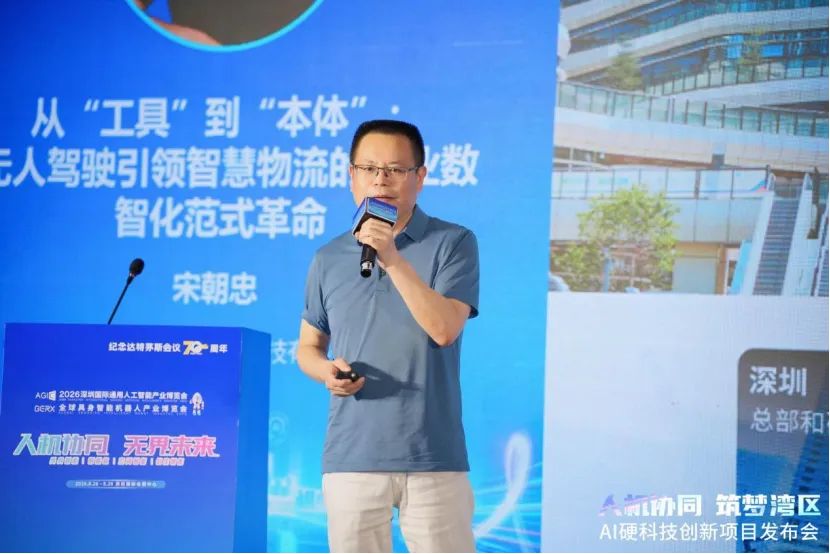
Song Chaozhong, CEO of Echiev (Shenzhen Echiev Autonomous Driving Technology Co., Ltd.), presented “From Tools to Autonomous Systems: How Self-Driving Technology Is Transforming the Digital Landscape of Smart Logistics.”
The company’s core strengths lie in its proprietary full-stack autonomous driving technology for industrial sites and its independent perception and decision-making algorithms. These technologies move beyond the traditional model of logistics equipment that relies on human operation and passive execution, enabling vehicles to perceive their surroundings, make decisions, and coordinate operations autonomously.
The technology has been deployed in logistics operations across factories, industrial parks, and warehouses, including enclosed and semi-enclosed environments, supporting end-to-end autonomous logistics workflows.
Song also examined key challenges facing the large-scale deployment of autonomous logistics systems, including cost management, operational safety, risk control, and evolving business models. His presentation offered practical insights into the commercialization and scaling of intelligent logistics.
Embodied Skills | Building a Data-Driven Factory for Light Manufacturing
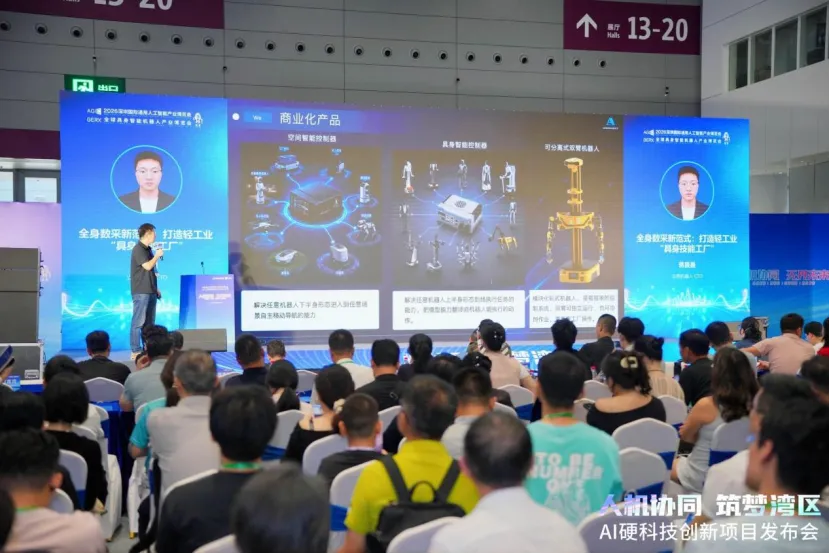
Jiang Chenchen, Co-Founder and CTO of LEON (Shenzhen) Robotics Technology Co., Ltd., shared the company’s embodied skills factory solution for light manufacturing.
Light manufacturing faces challenges such as intricate production processes, heavy reliance on manual labor, limited adaptability of conventional automation equipment, and difficulties in digitally preserving skilled manufacturing techniques.
To address these issues, the company has developed proprietary high-precision full-body motion data acquisition technology and process replication algorithms.
The solution captures and analyzes the practical techniques of frontline workers, transforming fragmented, experience-based manual operations into standardized motion models that robots can recognize, reuse, and replicate. This enables intelligent upgrades to light manufacturing production lines without requiring extensive reconstruction.
The solution has been adapted to multiple light manufacturing scenarios, addressing persistent industry challenges such as labor shortages, rising labor costs, and the loss of critical manufacturing expertise.
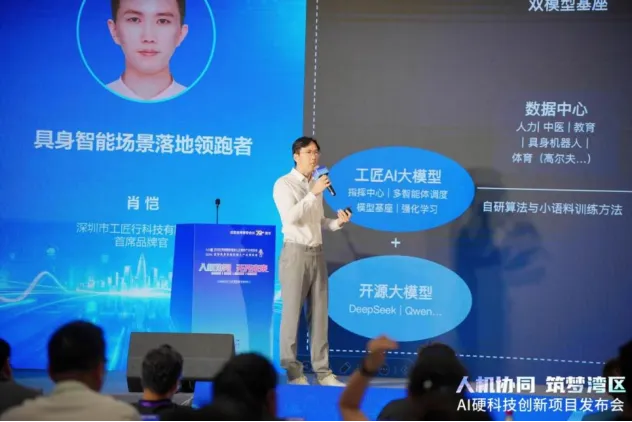
Embodied Intelligence | Bringing Robotics into Real-World Industrial Operations
Xiao Kai, CMO of Craftsmanship (Shenzhen) Technology Co., Ltd., discussed the challenges of commercializing embodied intelligence.
While many embodied AI technologies remain at the demonstration stage in laboratory environments, deploying them in complex industrial conditions requires greater reliability and adaptability.
The company focuses on real-world industrial maintenance applications and has developed integrated hardware and software solutions for industrial-grade embodied intelligence. Its technologies address key challenges such as environmental perception, adaptation to dynamic operating conditions, and stable, high-precision task execution.
Supported by proprietary adaptation algorithms and a modular hardware architecture, the solutions are designed for demanding industrial environments, including equipment maintenance and inspection. The presentation demonstrated how embodied intelligence can move beyond laboratory demonstrations toward commercial pilots and scalable industrial deployment.
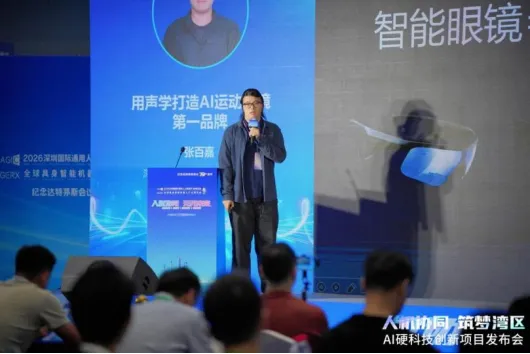
Acoustic AI Glasses | Exploring a New Direction for Wearable Intelligence
Zhang Baijia, Co-Founder of Shenzhen Qianhai Wuxing Semiconductor Technology Co., Ltd., presented the company’s innovations in acoustic AI wearables.
Traditional vision-based AR glasses often face challenges such as high power consumption, motion discomfort, and limited adaptability across usage scenarios. In response, the company has adopted an audio-first interaction approach, supported by two key technologies: on-device AI computing optimization and spatial audio algorithms.
Its acoustic AI glasses are designed for everyday scenarios such as office work, commuting, and sports. Key capabilities include real-time voice interaction, multilingual translation, and context-aware intelligent assistance.
With a focus on low power consumption, adaptability, and wearing comfort, the product explores a new segment within consumer AI wearables and offers an alternative direction for intelligent hardware innovation.
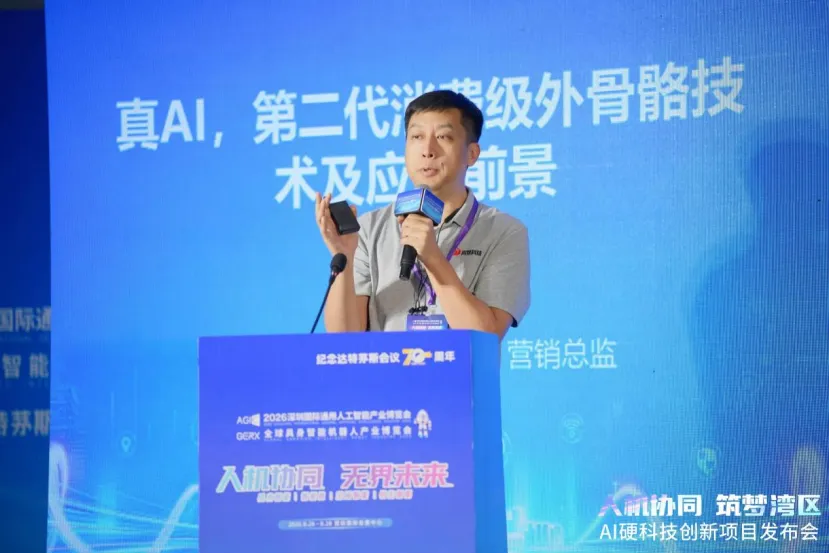
Consumer Exoskeletons | Advancing AI-Powered Mobility Assistance
Li Jianbing, Marketing Director of Shenzhen Kenqing Technology Co., Ltd., introduced the company’s second-generation consumer exoskeleton.
Compared with the first-generation product, which relied on fixed movement patterns and offered limited adaptability across different scenarios, the new model incorporates a proprietary AI-based motion-intent recognition algorithm.
The system can identify users’ movement intentions in real time and dynamically adjust assistance output accordingly, enabling more natural and responsive movement support.
Designed for multiple applications, including medical rehabilitation, everyday mobility assistance, and light industrial work, the technology aims to support people with mobility challenges while reducing physical strain in demanding work environments.
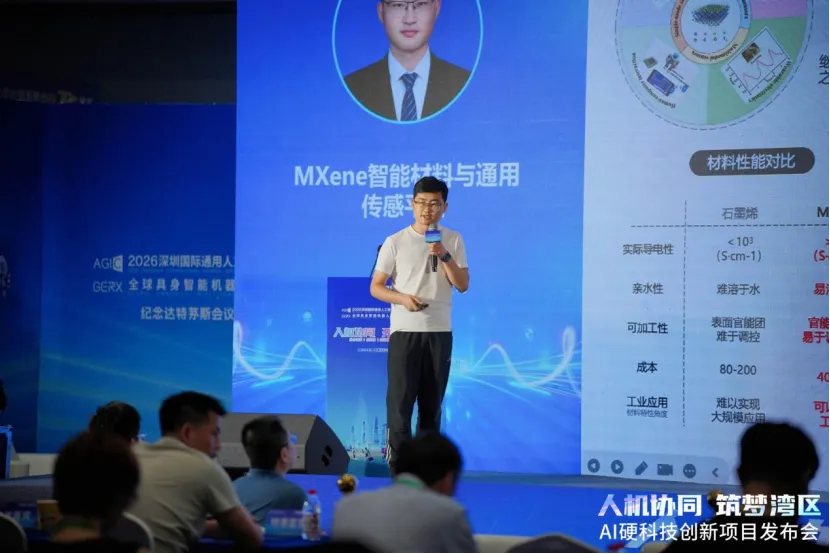
MXene Smart Materials | Enabling a Universal Sensing Platform
Kang Hui, Deputy General Manager of Harbin Yunjing Technology Co., Ltd., introduced the company’s latest developments in MXene smart materials and its universal sensing platform.
Leveraging proprietary modification technologies for two-dimensional MXene materials, the company has developed high-sensitivity, high-stability sensing capabilities.
Compared with conventional sensing materials, MXene offers excellent electrical conductivity, precise deformation detection, and compatibility with multi-signal data acquisition.
The platform can capture multiple types of data, including pressure, deformation, and physiological signals. It provides foundational sensing capabilities for a wide range of devices, including smart wearables, industrial intelligent hardware, and robotic systems.
The presentation highlighted the potential of advanced materials and sensing technologies as essential building blocks for next-generation AI hardware.
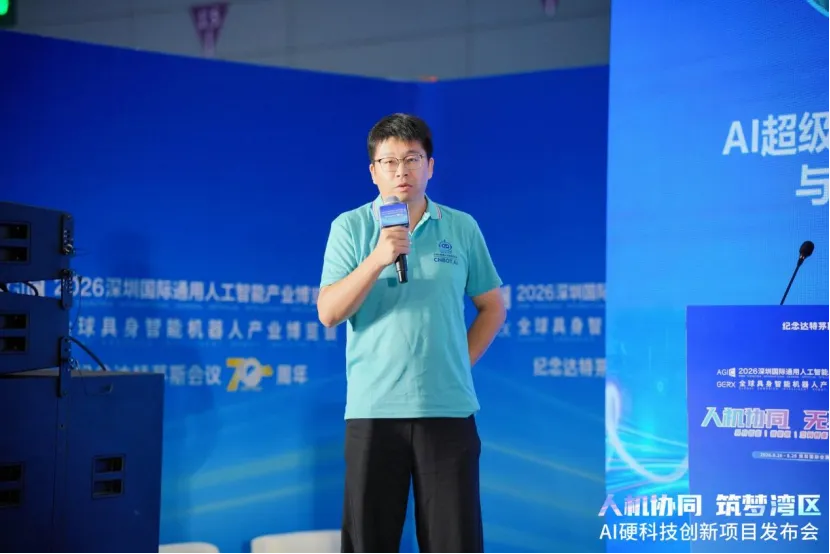
AI Super Employees | Transforming Enterprise Workflows
Li Pengfei, Technical Director of Global Dragon (Shenzhen) Digital Technology Co., Ltd., presented an AI agent solution designed to function as a virtual “super employee” for enterprise operations.
Built on customized industry-specific foundation models and workflow restructuring algorithms, the solution goes beyond the limitations of traditional single-function office software.
It can independently handle a wide range of business tasks, including content creation, customer relationship management, data analysis, and end-to-end workflow execution.
Designed for enterprise administration, marketing, and business operations, the solution aims to reduce labor costs, improve operational efficiency, and turn general-purpose AI capabilities into practical, everyday business applications.
Expanding Application Frontiers | Specialized Robotics and Investment Perspectives
This track focused on specialized applications in sectors such as agriculture and marine operations, showcasing advances in purpose-built robotics while examining investment opportunities in the AI hard-tech sector.
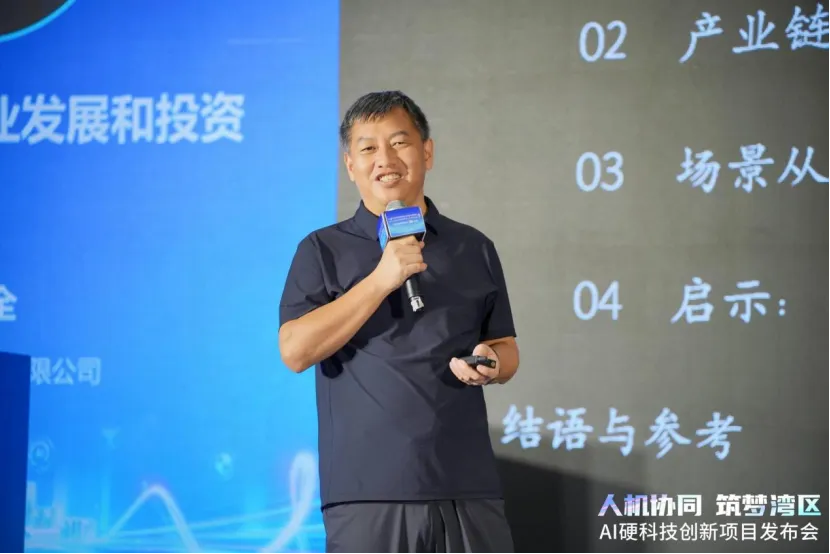
Industrial AI | Investment Perspectives on Emerging Hard-Tech Companies
Wang Haiquan, Founding Partner of Shenzhen Zhengxuan Investment Co., Ltd., shared his perspectives on the growth and development of industrial AI hard-tech companies from an investment standpoint.
Drawing on his experience in technology-sector investment, he examined the value of emerging AI segments and the key criteria used to assess investment opportunities.
He also offered practical guidance to startup teams on technology development, product commercialization, team building, and business model optimization. His insights provided useful references for managing industrialization risks and connecting innovative projects with capital markets.
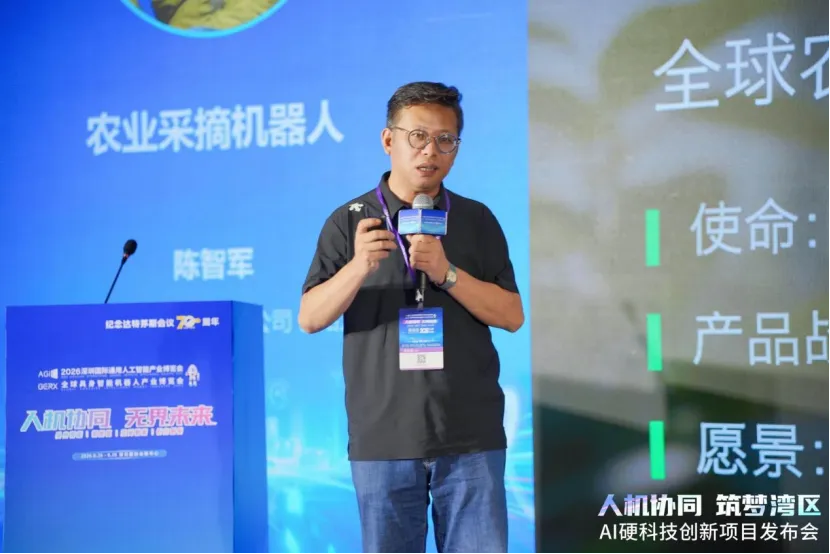
Agricultural Robotics | Automating Precision Harvesting
Chen Zhijun, Founder of Shenzhen LanXia Robotics Co., Ltd., introduced the company’s independently developed agricultural harvesting robots, addressing challenges such as labor shortages, low manual harvesting efficiency, and inconsistent harvesting precision.
The robots are built around two core technologies: proprietary visual recognition algorithms and flexible harvesting control systems. They can accurately identify fruit and vegetable maturity, avoid interference from branches and leaves, and perform automated harvesting with high precision while minimizing damage to crops.
The equipment has completed pilot deployments across multiple agricultural scenarios and is designed to support different fruit and vegetable cultivation environments.
By addressing labor shortages and the aging agricultural workforce, the technology aims to accelerate the large-scale adoption of intelligent agricultural equipment.
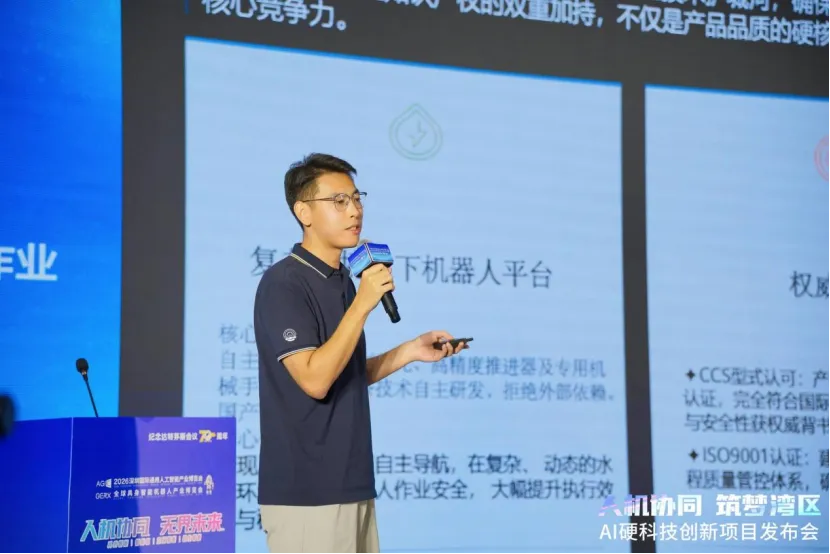
Underwater Robotics | Advancing Intelligent Marine Operations
Yi Wei, Marketing Director of Guangdong Lanqian Marine Technology Co., Ltd., presented the company’s latest developments in underwater robotics.
The company is applying embodied intelligence to next-generation marine equipment, supported by proprietary underwater environmental adaptation algorithms, high-precision underwater positioning, and operational control technologies.
Its innovations address key technical challenges, including perception in complex underwater environments, interference-resistant operations, and dynamic environmental adaptation.
The solutions are designed for applications such as underwater equipment inspection, marine engineering operations, and aquatic environmental monitoring, helping advance the development of high-end intelligent underwater equipment for civilian and industrial applications.
Connecting Technology, Industry, and Capital
Alongside the project presentations, the event featured dedicated networking and business matchmaking sessions. Startup teams, investment institutions, upstream and downstream industry partners, and business representatives held direct discussions on technology collaboration, product deployment, project financing, and supply chain integration.
These exchanges created opportunities for cooperation and strengthened connections between technological innovation, industrial applications, and investment resources.
As an important initiative within AGIC 2026 to support emerging technology companies, the showcase connected innovative startups with expert networks, leading investment institutions, the Greater Bay Area’s established supply chain ecosystem, and domestic and international buyers.
By linking these resources, the event aims to support the entire commercialization journey—from technology development and prototype testing to pilot deployment and large-scale manufacturing.
Looking ahead, the Shenzhen Artificial Intelligence Industry Association will continue identifying promising AI hard-tech innovators and providing ongoing support through technology showcases, resource matchmaking, brand development, and industrial incubation.
Through these efforts, the association aims to further strengthen the Greater Bay Area’s AI innovation ecosystem and help more homegrown hard-tech companies establish themselves in the region, expand across China, and contribute to digital transformation across industries.