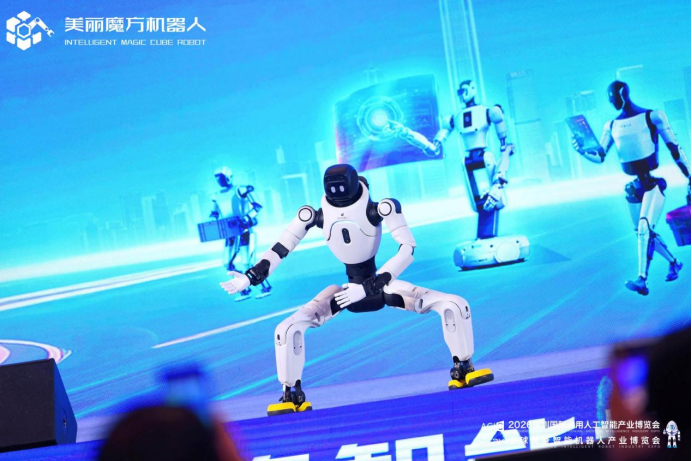
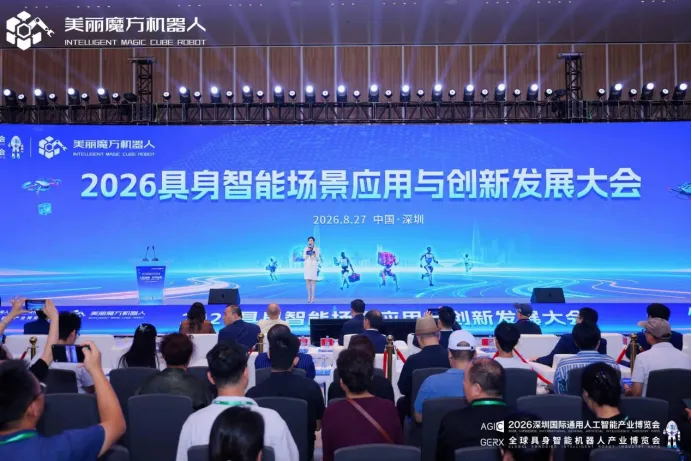
Held on the afternoon of August 27 at Mangrove Hall, Shenzhen World Exhibition & Convention Center (Bao’an), the 2026 Embodied Intelligence Applications & Innovation Development Forum brought together government officials, leading experts, business executives, and industry representatives under the theme “Human–Robot Collaboration, Boundless Possibilities.”
The forum explored how Embodied Intelligence can move beyond the laboratory and into real-world applications, translating technological breakthroughs into practical solutions that benefit industries and society.
Opening Remarks | Embodied Intelligence Ushering in a New Era
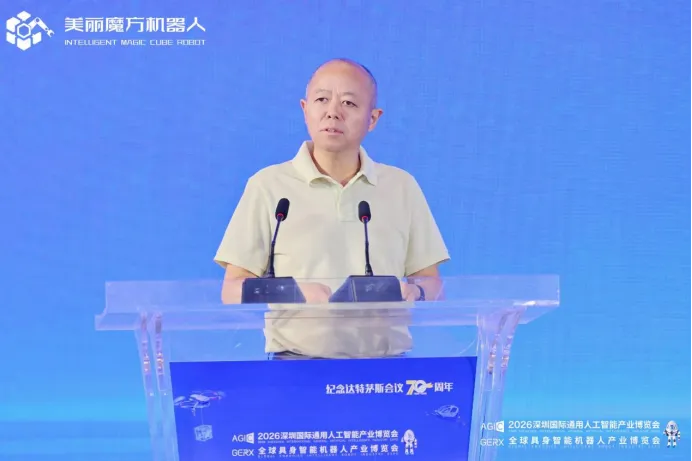
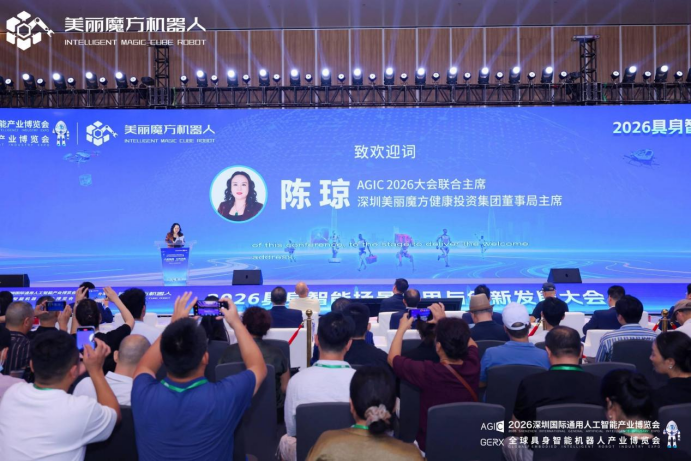
Wang Jiangping, Member of the 14th National Committee of the Chinese People’s Political Consultative Conference (CPPCC) and former Vice Minister of Industry and Information Technology, and Chen Qiong, Co-Chair of AGIC 2026 and Chairman of the Board of Shenzhen Meili Magic Cube Health Investment Group, delivered opening remarks.
From the perspectives of national strategy and new industrialization, Wang Jiangping highlighted the strategic role of Embodied Intelligence as a key driver of new quality productive forces. He also shared his expectations for deeper integration between the “Shangshan AI” philosophy and the real economy.
Chen Qiong welcomed the distinguished guests and expressed her hope that investment capital and innovation resources from across industries would converge around this promising sector.
Together, their remarks set the tone for closer collaboration among government, industry, academia, research institutions, and end users to accelerate the development and application of Embodied Intelligence.
Frontiers and Investment Perspectives | From Real-World Scenarios to a New Investment Paradigm
Wang Danwei, Fellow of the Singapore Academy of Engineering and Tenured Professor at Nanyang Technological University, delivered a presentation titled “Challenges and Opportunities for Embodied Intelligence Across Diverse Real-World Scenarios.”
He emphasized that bringing Embodied Intelligence into practical use requires a deep understanding of complex physical environments and a systematic approach to breaking down real-world challenges. A thorough understanding of diverse application scenarios is essential to identifying the right opportunities for technological breakthroughs.
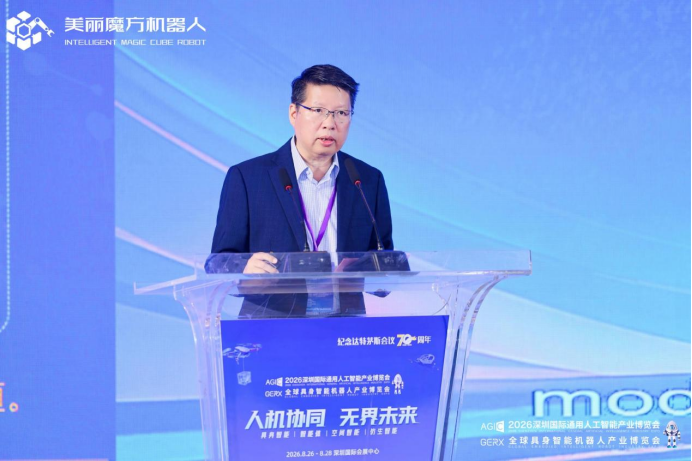
Lu Pei, Chief Analyst for the Machinery Industry at China Galaxy Securities, presented “From Large Language Models to Physical AI: A New Investment Paradigm for the Embodied Intelligence Industry.”
She noted that capital markets are increasingly backing the commercialization potential of Embodied Intelligence. Understanding the underlying investment dynamics will be critical to anticipating the industry’s development and accelerating its transition from technological innovation to commercial deployment at scale.
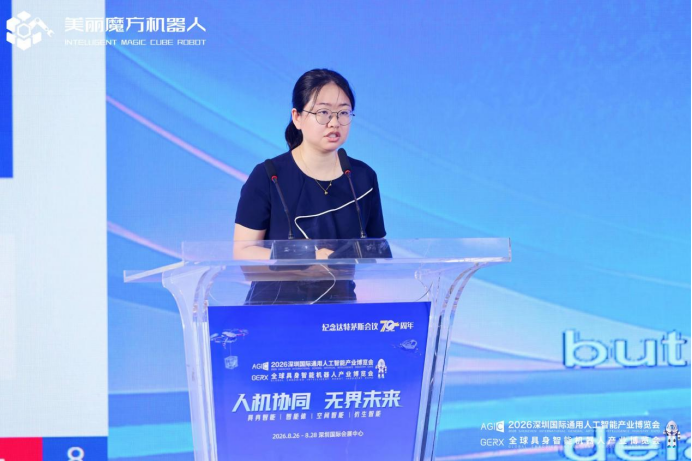
Gan Zhongxue, Director of the Institute of Intelligent Robotics at Fudan University, explored the evolution of Embodied Intelligence from cognitive architectures to swarm collaboration. His presentation illustrated how the field is moving beyond isolated technological breakthroughs toward system-level innovation, offering valuable insights for both academic research and industrial transformation.
Product Innovation and Ecosystem Development | From Human Wellbeing to Industrial Productivity
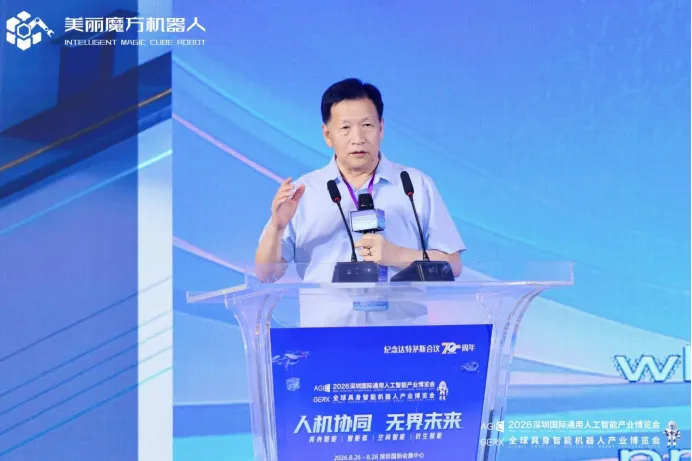
Tan Jiyong, Chief Technology Expert at Zhichuang Magic Cube Robotics and Director of the Guangdong Provincial Collaborative Innovation Center for Technology Supporting People with Disabilities, delivered a presentation titled “Intelligent Robotics Innovation and Applications for Human Wellbeing.”
By bringing together robotics innovation and assistive technology, he demonstrated how intelligent robots can help improve the quality of life for people with disabilities. His presentation highlighted the human-centered value of Embodied Intelligence: technology that makes a difference and innovation that delivers meaningful social benefits.
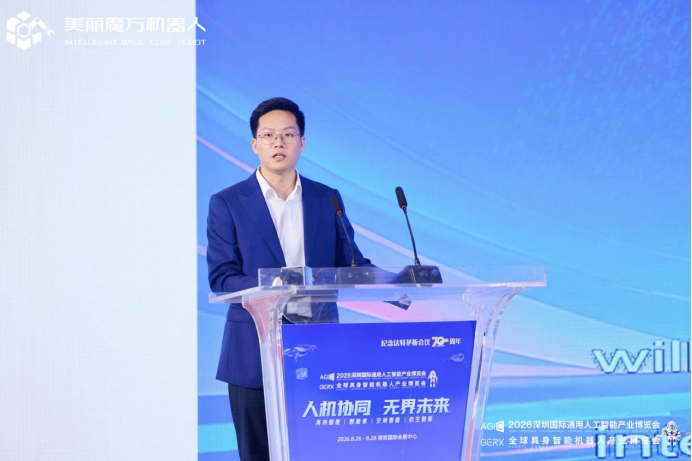
Li Shenggao, Senior Expert in Technology Planning at Shenzhen Highpower Technology Co., Ltd., presented “Powering the AI Revolution: Battery Innovation for Edge AI Devices, Robotics, and AI Data Centers (AIDCs).”
He highlighted how advances in energy density are helping drive the development of Embodied Intelligence. Innovation in foundational components and energy technologies will be essential to enabling more capable devices and supporting the industry’s transition toward large-scale deployment.
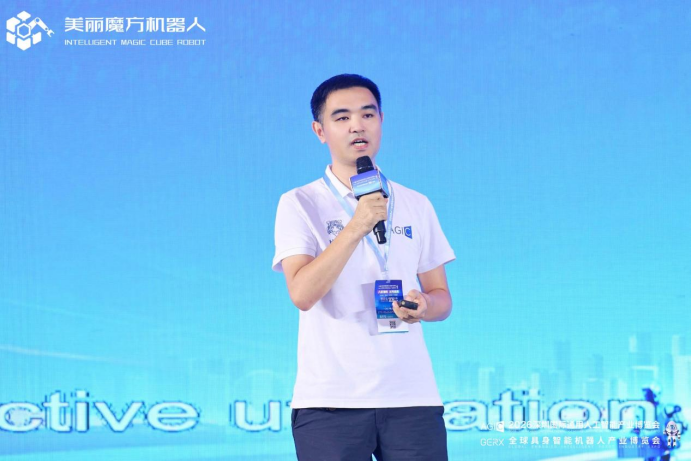
Zhao Yong, Researcher at the School of Manufacturing and Future Technology, Fuyao University of Science and Technology, delivered a presentation titled “3D Visual Perception: The ‘Eyes’ of Embodied Robots and the Evolution of Autonomous Locomotion.”
He explored the evolution from 2D image processing to 3D spatial understanding, explaining how advances in visual perception are enabling robots to better interpret their surroundings, navigate complex environments, and interact with the physical world.
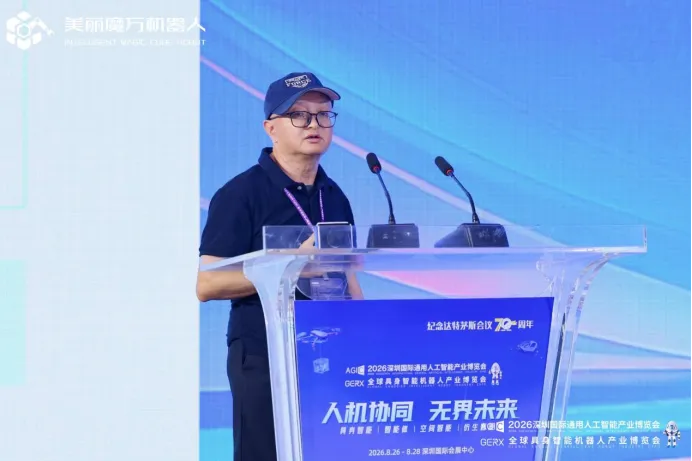
Feng Zhiyong, General Manager for Guangdong at AGIBOT, delivered the final presentation, titled “Ushering in a New Era of Productivity with Embodied Intelligence.”
He showcased the practical path from laboratory prototypes to industrial deployment, highlighting how Embodied Intelligence is moving beyond technology demonstrations toward robots capable of performing real tasks and contributing to productivity. This transition points to a new era in which intelligent robots are becoming increasingly valuable contributors across industrial and commercial environments.
From Algorithms on Screens to Intelligence in the Physical World
The central challenge of Embodied Intelligence is to accelerate the evolution of artificial intelligence—from Generative AI and AI Agents to Embodied Intelligence and Physical AI. It is about taking AI beyond the screen and bringing it into factories, onto roads, and into homes, where perception, decision-making, and execution can form a continuous loop in the physical world.
Covering real-world applications, investment, academic research, assistive technology, energy solutions, visual perception, and industrial productivity, the forum presented a broad picture of the industry’s progress from technological innovation to practical deployment.
As Embodied Intelligence increasingly becomes a bridge between humans and machines, every act of perception, every decision, and every action must be precise, reliable, and safe. Ultimately, the value of this technology lies not only in what intelligent machines can do, but also in how they can improve productivity, support human wellbeing, and create meaningful benefits for society.