Companies have invested in GPU workstations and rented substantial cloud computing resources, yet large language models (LLMs) and AI agents still struggle to operate effectively in enterprise environments. This is a common challenge for businesses preparing to embrace AI: computing power is available, but practical applications remain difficult to deploy; data cannot leave secure environments, and companies are reluctant to make full use of advanced models. Desktop workstations, edge inference servers, and cloud-based Token resources often operate independently, leaving AI agents fragmented across three separate computing environments.
What enterprises truly need is not simply more computing power or higher hardware specifications. They need secure, controllable, stable, and sustainable AI inference capabilities that enable AI to perform real tasks and drive actual business operations.
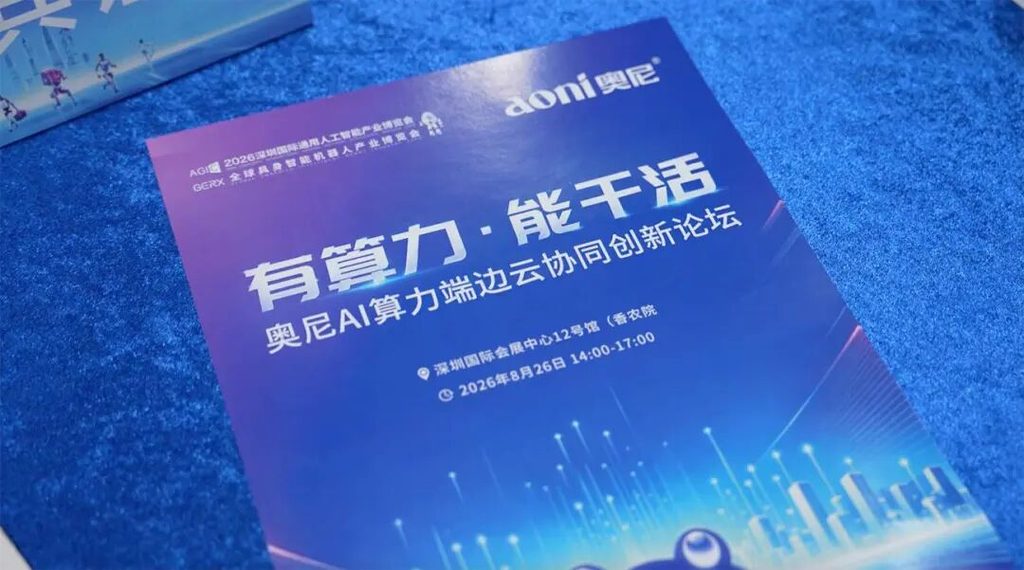
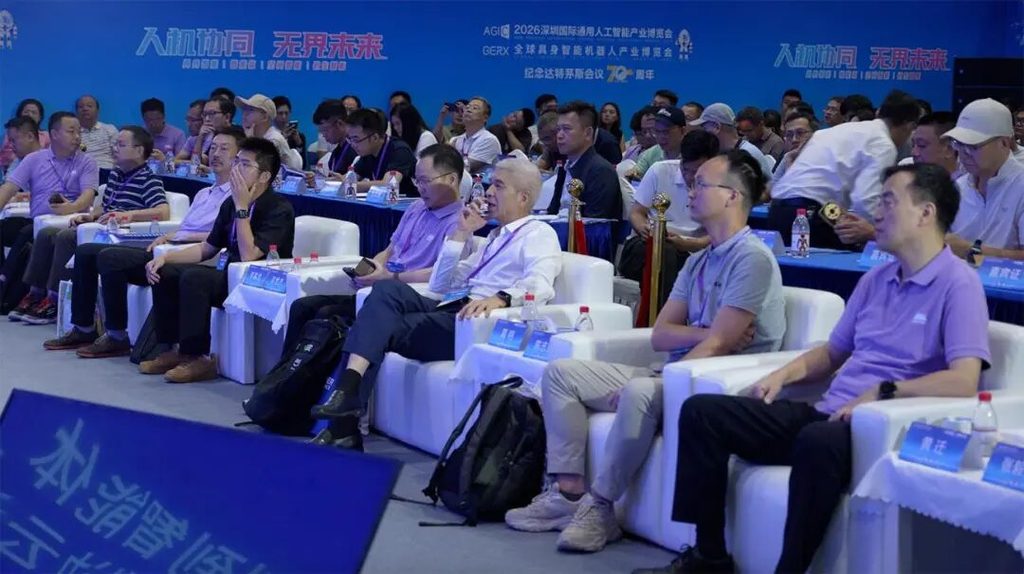
On August 26, during the 2026 Shenzhen International General Artificial Intelligence Industry Expo (AGIC 2026), Shenzhen Aoni Electronic Co., Ltd. hosted the “From Computing Power to Real-World Productivity: Aoni AI Computing Infrastructure Innovation Forum on On-Device, Edge and Cloud Collaboration” at Shannon Hall, Hall 12, Shenzhen World Exhibition & Convention Center (Bao’an).
Organized by the Shenzhen Artificial Intelligence Industry Association and undertaken by Aoni Electronic, the forum brought together experts from academia, AI infrastructure, intelligent agents, and industrial applications. Aoni unveiled its enterprise-grade private Token Infra business framework, presenting an integrated pathway from accessing computing resources and generating Tokens to deploying AI capabilities in real business operations.
Strategic Vision | Investing in AI Inference to Connect the Entire Value Chain from Models to Business
What do enterprises really need from computing infrastructure? This question lies at the heart of Aoni’s strategic direction.
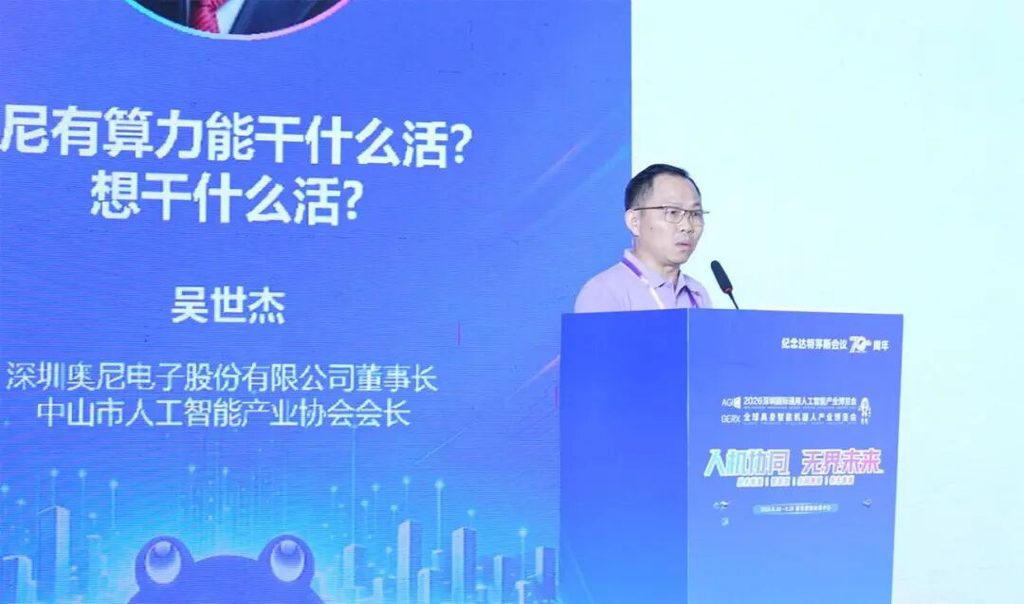
At the opening of the forum, Wu Shijie, Chairman of Aoni Electronic, delivered an address titled “Aoni’s Strategic Choice: Becoming a Leading Provider of AI Inference Computing Infrastructure.”
He noted that as AI computing shifts from model training toward large-scale inference, the number of AI agents and the frequency of their interactions are growing rapidly. Enterprise demand is therefore moving beyond the occasional execution of AI models toward a continuous and reliable supply of intelligence.
In response to this shift, Aoni is focusing on enterprise-grade private AI inference infrastructure. Its strategy connects chips, servers, and computing clusters at the infrastructure level, while supporting models and AI agent applications at the software level. Through coordinated deployment across on-device, edge, and cloud environments, Aoni aims to bring AI computing capabilities directly into employee workflows, enterprise operations, and frontline business processes, while progressively expanding its AI inference infrastructure footprint across China and international markets.
Key Launch | Building an Enterprise-Grade Private Token Infra Across On-Device, Edge and Cloud Environments
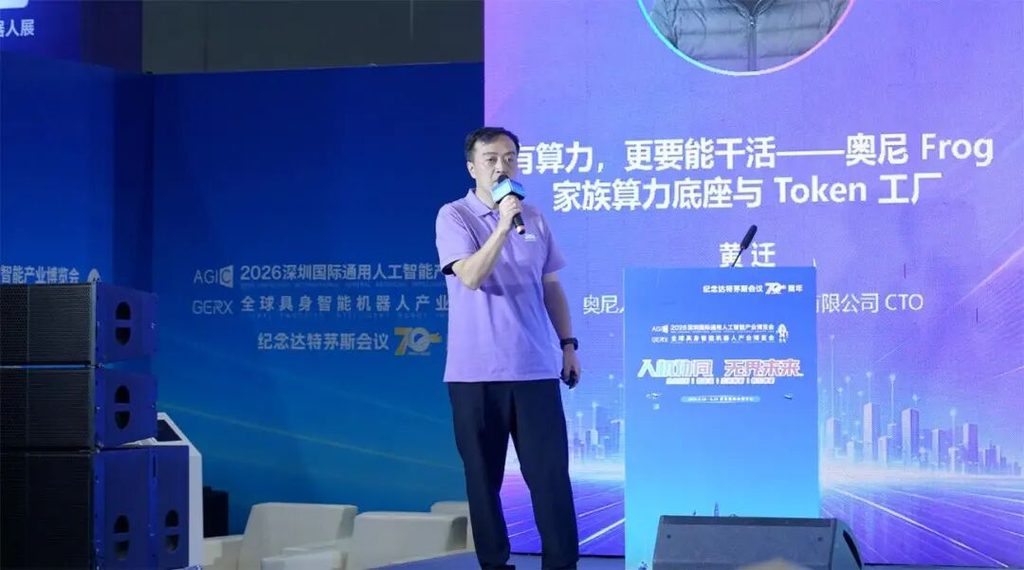
How can this strategy be translated into practical solutions? Huang Qian (Gavin), CTO of Aoni Electronic, presented the answer in his keynote and media interview: an enterprise-grade private Token Infra framework designed for the AI agent era.
In Aoni’s view, enterprises do not simply need standalone GPUs, servers, or computing specifications. They need a continuous supply of Tokens to support model inference, AI agent operations, and real business applications.
Cloud | CloudFrog: An Enterprise Private Token Factory
At the cloud level, Aoni’s framework is powered by CloudFrog, its enterprise private Token factory. It transforms underlying GPU resources into Token as a Service (TaaS) that enterprises can use directly.
In his interview, Gavin explained that CloudFrog is not simply a conventional computing-power rental service. It is a distributed Token factory and computing cluster. In addition to its first facility in Shenzhen, Aoni has established data centers in Yunnan and Qingyang, Gansu, enabling it to deliver ready-to-use inference services directly to customers.
Addressing one of the most sensitive concerns for enterprises—data leaving secure environments—Gavin emphasized two core principles: data stays within its designated environment, and customer data is never fed back into external model training.
All customer data accessed through the service is stored within the enterprise’s designated region and isolated from other customers’ data through strict tenant-level controls. Unlike business models in which service providers may use customer data to train their models, Aoni’s cloud computing resources are privately provisioned for enterprises, with no extraction or recycling of customer data for external model training.
This approach is designed to remove one of the biggest barriers preventing enterprises from adopting and fully utilizing large AI models.
Edge | EdgeFrog: Deployable Enterprise AI Micro-Nodes
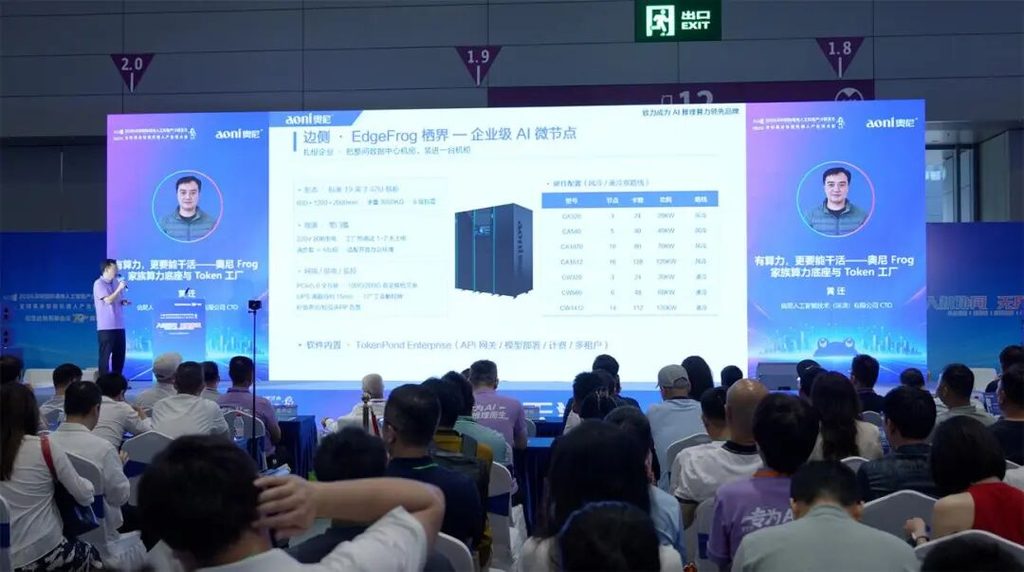
At the edge level, Aoni introduced EdgeFrog, an enterprise-grade AI micro-node designed to transform the capabilities of a traditional professional server room into a private computing foundation that can be deployed quickly and operated continuously.
Gavin outlined two key aspects of its design. From a hardware perspective, the complete AI computing cluster is integrated into a 42U rack, incorporating computing nodes, storage, networking, and an uninterruptible power supply (UPS), with air conditioning included as standard. It operates on standard 220V mains electricity without requiring a separate three-phase power connection. Installation can be completed in a customer’s existing server room in as little as one to two days.
On-Device | NeoFrog: Desktop AI Workstations for Enterprise Users
At the on-device level, NeoFrog desktop AI workstations bring high-performance inference capabilities directly to employees and developers, enabling large language models, enterprise knowledge bases, and AI agents to run within the organization’s own environment.
Gavin also introduced TokenPond, Aoni’s unified platform for managing computing resources, Tokens, models, and applications across on-device, edge, and cloud environments.
TokenPond intelligently allocates resources according to task complexity, hardware utilization, and security requirements. The platform is available in three configurations: an on-device workstation edition, an enterprise edition, and a general-purpose cloud Token factory edition.
Together, these configurations connect previously fragmented computing resources into a unified system. Within an enterprise, an AI agent can use the computing power of a local workstation, access edge resources through intelligent routing, or connect directly to cloud inference resources provided by the Token factory. The allocation process is seamless from the user’s perspective.
According to Gavin, this integrated on-device, edge, and cloud architecture directly addresses two major barriers to enterprise AI adoption.
First, the computing resources required by AI agents have traditionally been fragmented across desktop workstations, edge inference servers, and cloud platforms, making it difficult to run business-critical applications effectively. Second, many enterprises are not unwilling to adopt large AI models; they simply lack the confidence to use them because of data security and privacy concerns.
By coordinating all three computing environments, Aoni aims to keep data within controlled environments while ensuring that cloud resources are also privately provisioned and do not feed customer data back into external systems. This gives businesses greater confidence to adopt large AI models and integrate intelligent applications into their actual operations.
Industry Standards | From Product Specifications to Industry Benchmarks, Building an AI Agent Ecosystem
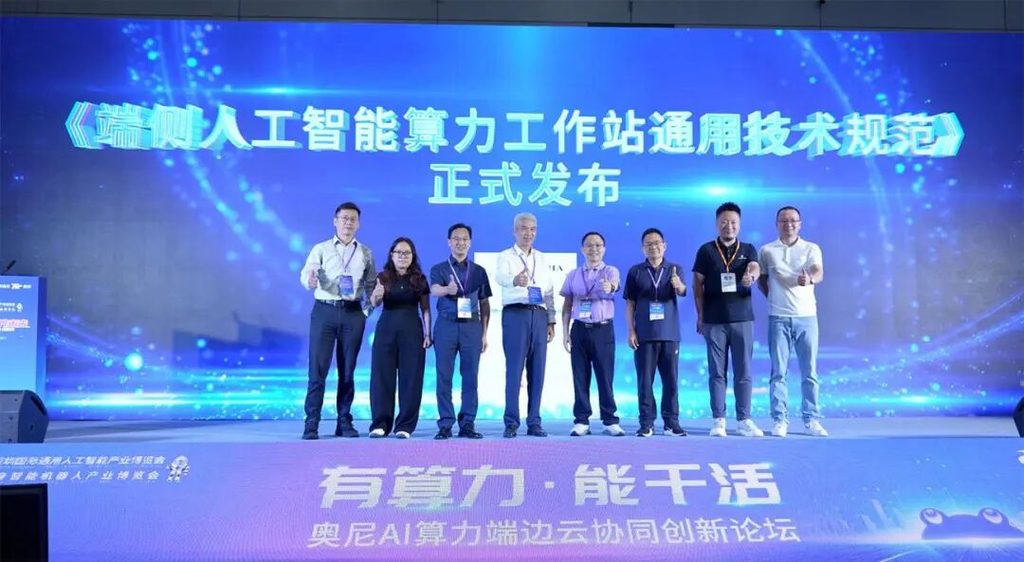
At the forum, China’s first group standard for on-device AI workstations, the General Technical Specification for On-Device Artificial Intelligence Computing Workstations (T/AIIA 023—2026), was officially released.
Proposed and led by Aoni Electronic, the standard was jointly developed with 13 other organizations across the industry value chain, bringing the total number of participating organizations to 14.
It establishes a three-tier classification system for computing capabilities:
- Consumer Grade (C)
- Professional Grade (P)
- Enterprise Grade (E)
The standard also incorporates Agent OS into its technical requirements for the first time, specifies offline operating capabilities, and introduces three security levels: S1 Open, S2 Enterprise, and S3 Fortress.
The standard is scheduled to take effect on September 1, 2026.
With this framework, the industry will have measurable and verifiable criteria for evaluating AI workstations, including their performance classifications, computing capabilities, and ability to keep data within local environments.
Ecosystem Collaboration | Bringing AI Agents into Real-World Enterprise Operations
The successful deployment of AI agents in enterprises requires more than computing infrastructure alone.
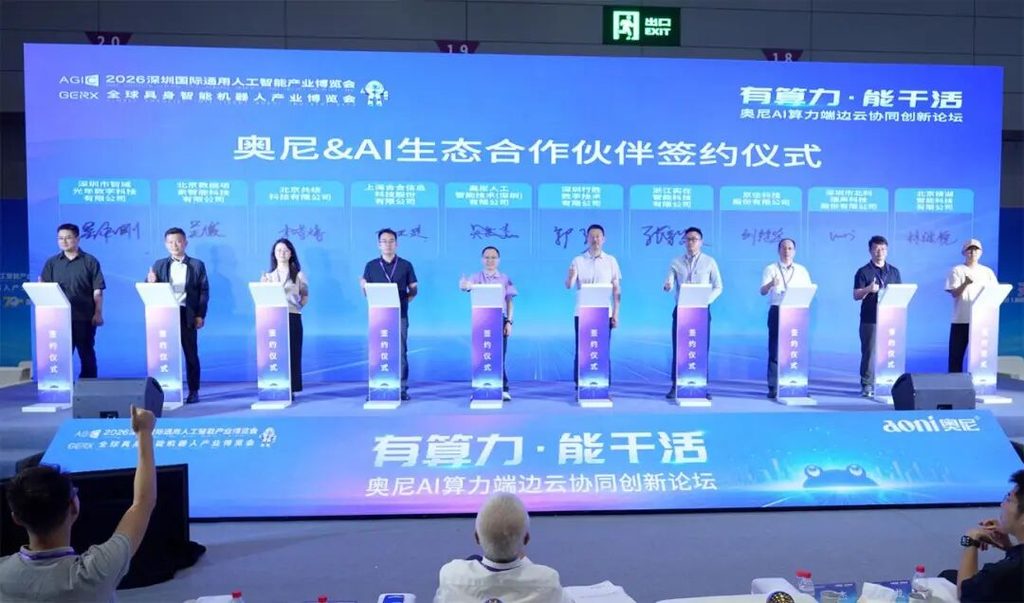
At the forum, Aoni signed cooperation agreements with nine ecosystem partners: IntSig Information Co., Ltd., Jingxin Technology, Intelligence Indeed, DataElem, ComNergy Tech Limited, Shenzhen Xingsheng Digital Technology Co., Ltd. , Shenzhen Raisound Technology Co., Ltd., Mohu Intelligent, and Zhiyu Guangnian.
Dr. Guo Sha of Hangsheng Digital and Zhang Yiwen of Shizai Intelligent also shared insights into enterprise AI agents, industrial productivity, and practical applications of agent technologies.
During the roundtable discussion, representatives from Aoni, Gongji Technology, Data Xiangsu, Wulianghuo, Beike Ruisheng, and other companies explored the AI infrastructure required to support the large-scale deployment of AI agents.
Looking Ahead | Computing Power Is the Starting Point. Real-World Productivity Is the Goal.
The forum delivered a clear and practical message: computing power is only the starting point; enabling AI to get real work done is the ultimate goal.
The next step is to channel Tokens into AI agents, bring those agents into real business workflows, and make AI genuinely useful across industries.
The journey toward enterprise-ready AI inference infrastructure and the large-scale adoption of AI in industry has only just begun.