

Everyone Wants to Build Robots. But How Many Will Survive?
Robot exhibitions have been buzzing with activity since the beginning of the year. At this year’s World Humanoid Robot Games and related industry showcases, for example, more than 300 companies exhibited over 2,000 products, including more than 150 new product launches. The number of exhibitors rose 36% year over year, while the number of exhibits increased by 27%.
Automakers, mapping and navigation platforms, and consumer electronics brands have all taken the stage. Humanoid and quadruped robots have demonstrated their walking capabilities and interactive features, while investors have applauded the prospect of a trillion-yuan market.
Yet beneath the excitement lies a question that the industry can no longer afford to ignore: As established companies from a wide range of sectors enter the robotics race with substantial resources at their disposal, how many will actually make it through the commercialization bottleneck?
The prospect of a trillion-yuan market has attracted a growing crowd of contenders. But unveiling a prototype is not the same as securing real customer orders, and deep pockets do not automatically translate into manufacturing expertise or proven industry experience.
A comparison between established industry players and new entrants suggests that the embodied AI sector is unlikely to replicate the story of how China’s new energy vehicle startups disrupted the traditional automotive market.
01. A Crowded Field: More Companies Are Entering the Humanoid Robotics Race
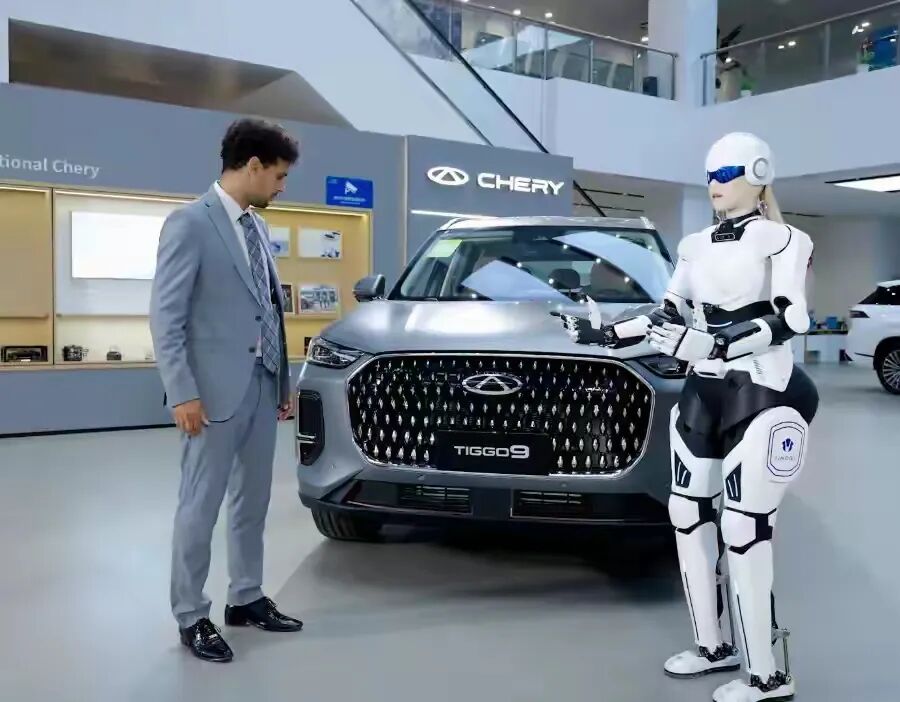
Chery and XPeng are bringing capabilities developed in the automotive industry into humanoid robotics. Amap, Alibaba’s mapping and navigation platform, has introduced multiple embodied AI models and robot products. Xiaomi and Honor have also brought their robotics offerings into the public eye.
Major technology companies are equally reluctant to miss out. Rather than manufacturing robots themselves, some are focusing on algorithms, foundational models, and computing platforms that can empower hardware partners.
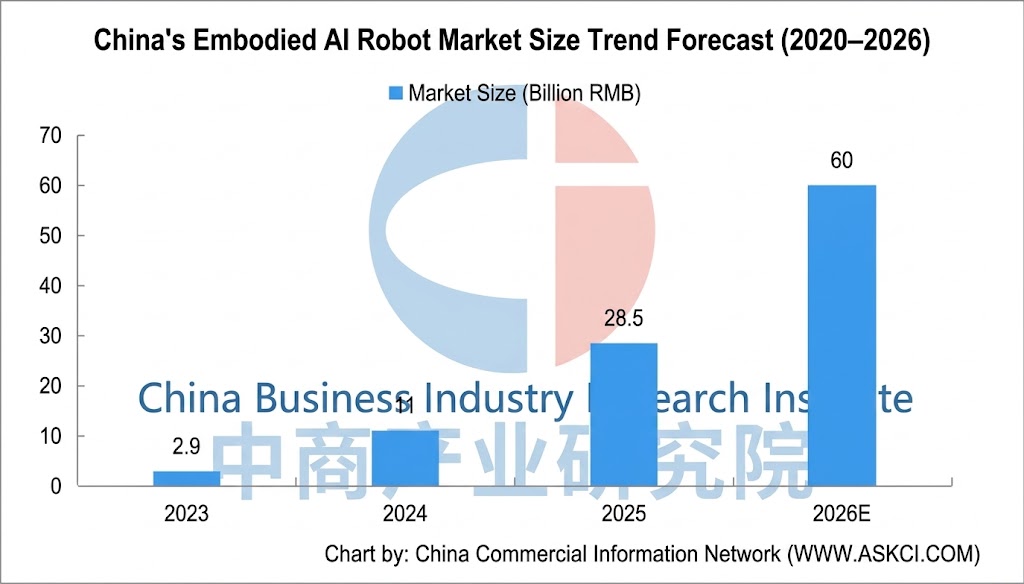
According to the China Commercial Industry Research Institute, China’s embodied AI robotics market is projected to reach RMB 6 billion in 2026, with long-term expectations pointing toward a market worth trillions of yuan. China’s 15th Five-Year Plan period has also placed robotics within the broader strategic emerging industries agenda, adding policy support to an already capital-intensive and highly competitive sector.
As more players enter the market, however, the boundaries of the industry are becoming increasingly blurred. Some companies connect existing equipment to a large-model interface and rebrand the result as embodied AI.
For some cross-industry entrants, robotics is little more than an exploratory initiative or a potential second growth engine to offset pressure on their core businesses. Far fewer appear willing to invest the sustained effort required to refine motion control, hardware reliability, and real-world performance.
On exhibition floors, robots may perform flawlessly. Yet engineers familiar with the development process acknowledge that even a ten-minute demonstration can require a team to spend the entire night troubleshooting and fine-tuning the system. In real operating environments, where conditions are less predictable, failure rates can rise sharply.
The influx of new entrants does not change a fundamental reality: Most cross-industry players remain at the prototype stage, while evidence of large-scale commercial delivery is still limited.
That said, these companies are not all pursuing the same goals. Their strategies differ considerably, and the industry’s competitive landscape is becoming increasingly fragmented.
02. Different Players, Different Strategies
Cross-industry entrants are taking distinctly different approaches to the robotics market.
Big Tech: Building the Software and AI Infrastructure
Major technology companies are largely pursuing a platform-led strategy.
Companies such as Huawei, Tencent, and ByteDance’s Seed research team are exploring different ways to participate in the robotics ecosystem. Some are developing general-purpose robotics foundation models and open platforms. Others aim to provide the underlying infrastructure, leaving physical robot manufacturing to hardware partners and seeking revenue through licensing, platform services, and related offerings.
This approach avoids much of the capital expenditure and operational complexity associated with hardware manufacturing. However, it comes with a critical dependency: the business model can only work if enough hardware manufacturers are willing to adopt these platforms and integrate them into commercially viable products.
Automakers: Manufacturing Strength Is Not Enough
Automakers are among the most closely watched cross-industry entrants.
XPeng, BYD, and Changan can draw on their experience in electric motors, batteries, supply chain management, and large-scale manufacturing. He Xiaopeng, XPeng’s chairman and CEO, has also taken a direct role in the company’s robotics business, signaling that the industry is moving closer to mass production.
Yet the ability to manufacture vehicles does not automatically translate into expertise in robotic joint actuation, dynamic balance, or whole-body motion control.
BYD has reportedly viewed robot manufacturing as a manageable extension of its existing capabilities. However, publicly available shipment figures have yet to establish an overwhelming scale advantage for its robotics products.
Consumer Electronics Brands: A Lower-Cost Entry Point
Consumer electronics companies tend to favor products that are closer to their existing capabilities and require less upfront investment. Some are exploring the transition from products such as robot vacuum cleaners and companion robots toward more advanced forms of embodied AI.
This provides a relatively low-cost way to enter the market and capitalize on growing interest in robotics. However, adding AI features or adopting the embodied AI label does not necessarily mean a product has achieved the level of autonomy, adaptability, or physical intelligence required for more demanding applications.
The Structural Disadvantage of Cross-Industry Entrants
Cross-industry players bring substantial advantages in capital, supply chains, distribution, and brand recognition. But they also face structural constraints.
Within large corporate groups, the core business usually receives priority when it comes to budgets, talent, and management attention. Robotics may remain a strategic option rather than an all-in commitment, making it difficult to sustain the level of investment required to overcome long development cycles and technical setbacks.
Specialist robotics companies, by contrast, often dedicate their entire organizations to developing and commercializing robots.
According to Smart Analytics Global, AgiBot and Unitree Robotics accounted for approximately 60%–70% of shipments in the first half of 2026. These domestic robotics specialists significantly outpaced many cross-industry entrants and overseas competitors in delivery volume, with a substantial share of shipments going to real-world industrial and commercial applications.
A prototype is relatively easy to build compared with a product that can be manufactured consistently at scale. Production yield, application-specific adaptation, after-sales service, and ongoing maintenance all require years of accumulated experience.
Once the novelty of a product launch wears off, the real competition begins. Success is no longer determined by how impressive a robot looks on stage, but by how reliably it performs in the field.
03. Why Embodied AI May Not Produce Its Own Wave of Disruptive Startups
The history of China’s new energy vehicle industry offers an attractive analogy. In just a few years, a new generation of automakers used product innovation to challenge established manufacturers and reshape the competitive landscape.
Many observers expect embodied AI to follow a similar trajectory, with new entrants leveraging their existing advantages to overtake established robotics companies.
Current industry signals, however, suggest that this scenario is far from inevitable.
Embodied AI is not a purely digital product. Hardware, algorithms, and real-world operating environments are deeply interconnected.
Industrial inspection demands appropriate protection ratings and dependable operation. Home service robots must prioritize safety and natural human-robot interaction. Emergency response robots need to navigate unpredictable terrain and hazardous environments.
There is no single universal robot capable of excelling in every application. Each market segment has its own technical requirements, operational constraints, and customer expectations. Even the largest technology companies may struggle to master all of them.
Specialist robotics companies build their competitive advantages through thousands of rounds of testing, iterative improvements to motion control algorithms, and the accumulation of application-specific data through real projects.
Industrial customers are unlikely to entrust critical operations to a newcomer without a proven track record. Trust takes time to establish, and no amount of capital can fully eliminate that requirement.
In theory, the industry is still at an early stage. Technical approaches have yet to converge, and the market remains highly fragmented. This limits the effectiveness of the scale advantages that large corporations typically rely on.
The principle of larger players acquiring smaller ones still applies, but the competitive dynamics may look very different from those seen in other industries.
A more likely outcome is a layered ecosystem in which major technology companies provide foundation models, computing infrastructure, and supply chain resources, while specialist robotics firms focus on specific applications and develop the expertise needed to serve them.
Investment, technology partnerships, and ecosystem collaboration could become the dominant model, rather than a winner-takes-all battle led by a single company.
The Real Test Is Commercial Execution
In a booming market, every company wants to be part of a disruptive success story. But progress in hardware manufacturing has never been a sprint.
The embodied AI race is only just beginning.
Cross-industry entrants are bringing capital, visibility, and new resources to the sector. Specialist robotics companies, meanwhile, are working to refine their products, improve delivery capabilities, and establish sustainable commercial models.
These two groups are not necessarily locked in a straightforward battle for survival. Their capabilities may increasingly overlap, complement one another, and converge through partnerships and technological exchange.
Not every company entering the market will survive long enough to see the industry mature. Financial strength alone does not guarantee a place among the winners.
Ultimately, the decisive question is whether a company can build robots that perform useful work reliably, repeatedly, and economically in real-world environments.
As the initial excitement subsides and commercial realities take center stage, the companies that endure will be those that can turn impressive demonstrations into dependable products and sustainable businesses.
For now, the question remains open: Who will still be standing when the robotics boom finally matures?