
On the afternoon of August 27, 2026, the 2026 Conference on Embodied Intelligence Applications and Innovation Development was held at the Mangrove Hall of the Shenzhen World Exhibition & Convention Center (Shenzhen World), Bao’an.
Under the theme “Human–Machine Collaboration · A Boundless Future,” the conference brought together government leaders, academicians and experts, business leaders, and industry representatives to explore how embodied intelligence can move beyond the laboratory into real-world applications, and from technological breakthroughs toward broad-based industrial adoption and benefits.

Opening Remarks: Embodied Intelligence Enters a New Chapter
Wang Jiangping, a member of the 14th National Committee of the Chinese People’s Political Consultative Conference and former Vice Minister of the Ministry of Industry and Information Technology, and Chen Qiong, Co-Chair of AGIC 2026 and Chairman of the Board of Shenzhen Meili Magic Cube Health Investment Group, delivered opening remarks.
Wang Jiangping highlighted the strategic significance of embodied intelligence in advancing China’s new industrialization and emphasized its potential as a key driver of new quality productive forces. He also expressed expectations for the deeper integration of the “Shangshan AI” philosophy with the real economy and industrial development.
Chen Qiong warmly welcomed the distinguished guests and called for greater convergence of cross-sector capital, innovation resources, and industry expertise around this rapidly evolving field with vast potential.
Together, the two opening addresses set the tone for the conference, emphasizing closer collaboration across government, industry, academia, research, and real-world applications to accelerate the development and adoption of embodied intelligence.


Frontier Exploration and the Investor Perspective: From Real-World Scenarios to New Investment Paradigms
Wang Danwei, Fellow of the Singapore Academy of Engineering and Professor Emeritus at Nanyang Technological University, delivered a keynote address titled “Challenges and Opportunities for Embodied Intelligence Across Real-World Scenarios.”
He emphasized that the successful deployment of embodied intelligence depends on a deep understanding of complex physical environments and a systematic approach to breaking down real-world scenarios. Only by fully recognizing the diversity and complexity of these scenarios, he noted, can the industry identify precise entry points for technological breakthroughs and accelerate the transition from innovation to practical applications.
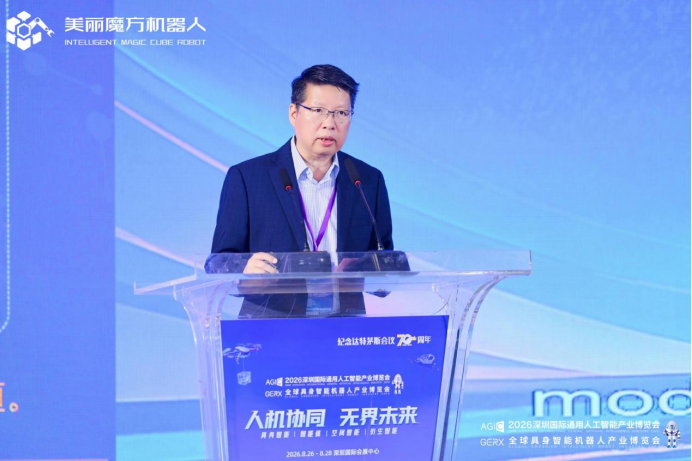
Lu Pei, Chief Analyst covering the Machinery Industry at China Galaxy Securities, delivered a presentation titled “From Foundation Models to Physical AI: A New Investment Paradigm for Embodied Intelligence.”
She noted that capital markets are increasingly signaling their confidence in the commercialization prospects of embodied intelligence through substantial investment. Understanding the underlying investment logic, she emphasized, is essential to accurately assess the pace of industry development and identify opportunities as the sector moves from technology-driven narratives toward large-scale commercial deployment.

Gan Zhongxue, Director of the Institute of Intelligent Robotics at Fudan University, explored the evolution of embodied intelligence from cognitive architectures to multi-agent collaboration, demonstrating how the field is moving beyond isolated technological breakthroughs toward system-level transformation. His insights provided valuable guidance for both academic research and the translation of cutting-edge innovations into real-world industrial applications.

Product Innovation and Ecosystem in Practice: From Human Well-Being to Real-World Productivity
Tan Jiyong, Chief Technology Expert at Zhichuang Magic Cube Robotics and Director of the Guangdong Innovation Center for Science and Technology–Enabled Disability Assistance, delivered a presentation titled “Intelligent Robotics Innovation and Applications for Human Well-Being.”
Bridging technological innovation with assistive solutions for people with disabilities, Tan demonstrated how embodied intelligence can go beyond improving productivity to enhance quality of life and promote greater inclusion. His presentation highlighted a powerful principle: technology can be human-centered, and innovation can create meaningful social impact.

Li Shenggao, Senior Technology Planning Expert at Highpower Technology, delivered a presentation titled “Powering the AI Revolution: Innovative Battery Solutions for Edge AI Devices, Robotics and AIDC.”
He emphasized that every breakthrough in energy density represents a critical step forward for embodied intelligence. Innovation at the level of foundational components and enabling technologies, he noted, is a crucial cornerstone for scaling the embodied intelligence industry and accelerating its transition toward mass deployment.

Zhao Yong, a researcher at the School of Manufacturing and Future Technologies at Fuyao University of Science and Technology, delivered a presentation titled “3D Vision Perception: The Eyes and Evolutionary Path of Autonomous Embodied Robots.”
He explored the evolution from 2D image-based perception to 3D spatial understanding, highlighting how advances in 3D vision are enabling robots to perceive, navigate, and interact with increasingly complex physical environments—effectively opening the door to a much broader physical world for embodied intelligence.

Feng Zhiyong, AgiBot in Guangdong, delivered the closing presentation, “Opening a New Era of Productivity with Embodied Intelligence.”
He showcased the practical pathway through which embodied intelligence is moving from laboratory prototypes into industrial environments—from simply demonstrating technological capabilities to delivering tangible value in real-world operations. The presentation underscored how embodied intelligence is beginning to reshape the way machines work alongside people, signaling the opening of a new era of AI-powered productivity.
From Algorithms on Screens to Intelligence in the Physical World
At the heart of embodied intelligence is a fundamental shift in AI: from generative AI toward AI agents, embodied intelligence, and physical AI. The goal is to take algorithms beyond the screen and bring them into factories, onto roads, and into homes—enabling a closed loop of perception, decision-making, and action in the physical world.
Spanning real-world scenarios, capital and investment, academic research, human well-being, energy infrastructure, visual perception, and industrial deployment, the conference presented a comprehensive picture of embodied intelligence’s journey from technological innovation to real-world applications.
As embodied intelligence becomes a bridge between humans and machines, every act of perception, every decision, and every action can be translated into precise execution, safe and reliable operation, and tangible benefits for people. This is the broader promise of embodied intelligence: not simply making AI more capable, but enabling intelligence to operate meaningfully in the physical world and create lasting value for society.
